

Cable Production Challenges: Outdated Instructions
In cable manufacturing, every hour of downtime is not just an unfulfilled order — it is lost reputation. Outdated paper instructions and lengthy staff training slow down commissioning, while setup errors lead to expensive repairs. As a result, customers go where things are faster and more reliable.
When a new employee needs a week to understand a process chart, and an experienced setup technician spends hours searching for the right component — this directly affects deadlines.
Cable production is especially sensitive to such delays: a disruption on one line pulls the entire shipment schedule along with it. And every expensive repair is not only a bill for spare parts, but also time that could have been spent fulfilling orders.
Staff training becomes a constant distraction for experienced employees, while newcomers take a long time to reach the required productivity.
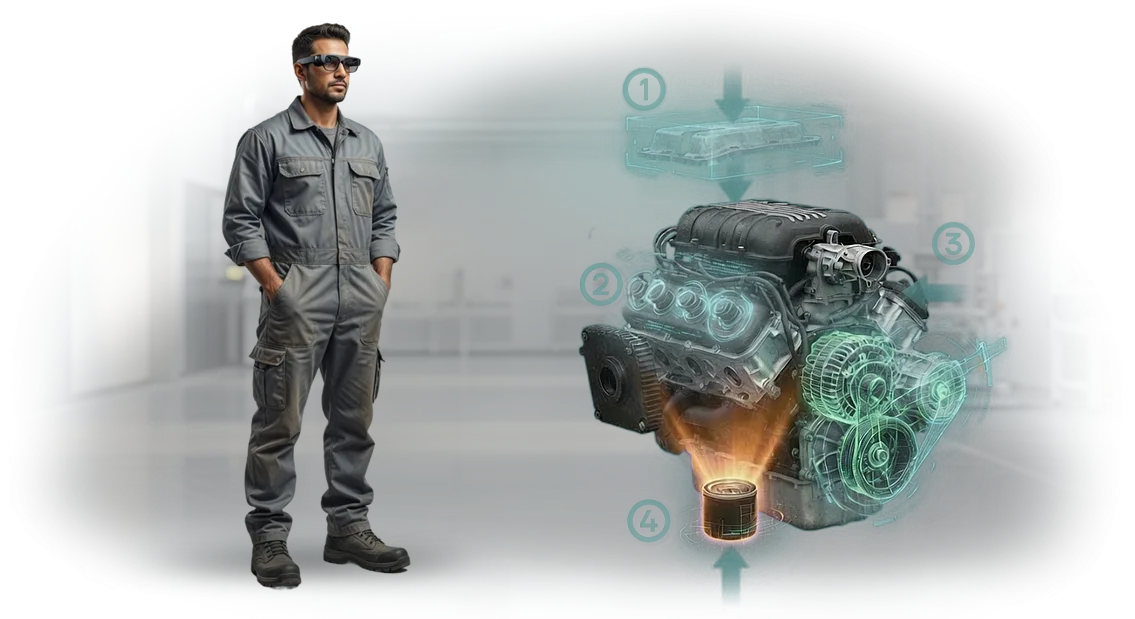
AR instructions for industrial facilities change the approach: step-by-step prompts right on the equipment, quick staff training without taking people away from work, and hands-on employee training on a real object.
This reduces commissioning time and lowers the risk of errors — which means less equipment downtime. Instead of thick binders and verbal explanations, you get clear prompts that are always at hand.
We help cable manufacturers transition to digital instructions and remote assistance. The customer gets fewer downtime hours, launches new lines faster, and retains clients because delivery commitments are met. This is not about technology for the sake of technology — it is about your revenue and reputation.
What an AR Instruction Delivers: From Faster Training to Fewer Accidents
An AR instruction turns staff training in cable production from a long process into something fast and clear. Instead of thick regulations, the operator sees prompts right on the equipment: what to take, where to press, which parameter to check. The employee reaches working speed several times faster — without weeks of supervising newcomers.
The second benefit is quality. Step-by-step control eliminates skipped stages: winding, insulation, marking — each step is visually confirmed, and the amount of defective products decreases.
For cable output, this means fewer reworks and more meters of finished product on the first attempt.
The third is reduced downtime. When a line stops, the operator does not wait for an engineer but receives troubleshooting instructions or calls for remote specialist assistance. Average recovery time decreases, and the plan is met without night shifts or emergencies.
The fourth is production safety. The instruction shows hazardous zones and the sequence of actions before an emergency situation occurs. Fewer injuries, fewer stoppages due to incidents, and a calmer workload for the engineering service.
And the fifth is reputation. A plant where a newcomer with a tablet masters a machine in one day looks modern and attracts qualified employees.
We implement such solutions remotely, in a language the operator understands, and the customer sees results in the first weeks of operation.
AR Instruction Formats for Different Tasks: From Setup to Repair
Each task in cable production requires its own approach to instructions. What is suitable for training a new employee will not work for an urgent machine repair.
That is why we develop AR instructions in different formats — matched to the specific task and the specialist’s skill level.
A properly chosen format directly affects work speed and the number of errors. A new operator memorizes operations faster, a service engineer acts more precisely during an unusual breakdown, and a manufacturer’s technologist can connect to the line without a business trip. Below is how this works in practice.
| AR Format | Who It Is For | What It Gives the Customer |
|---|---|---|
| Training scenario | New operators, setup technicians, trainees | Step-by-step prompts right on the equipment: the employee sees the sequence of actions while performing the operation. Time to full competence is reduced through visualization, and errors during initial shifts are minimized |
| Repair mode | Service engineers, repair crews | Visualization of components and the sequence of disassembly/replacement of parts. No need to flip through blueprints or search for documentation — all instructions are in the field of view, and equipment downtime becomes shorter |
| Remote support | Technologists, external manufacturer experts | The expert remotely sees the employee’s workstation, places markers, and guides actions by voice. The breakdown is resolved faster, and no visit to the enterprise is required |
All formats work in a single system and can be used at any stage — from component preparation to finished product control. You get not just a set of instructions, but a tool that accelerates training, reduces downtime, and decreases dependence on rare specialists. It works both in serial production and on unique custom lines.
Stages of AR Instruction Implementation: From Brief to Support
Implementing AR in cable production is a sequential process: from the project brief to launching the AR instruction and support. We walk with you through every stage, so you always understand what is happening. Below are the stages of AR development for your tasks.
- Brief and audit. We gather information: which operations cause the most defects, where training new employees is difficult, and how current instructions work. The output is an AR implementation plan with priorities and timelines.
- Scenario design. We break selected operations into step-by-step algorithms, taking into account real regulations and operator experience. This ensures that the AR instruction is a precise working tool, not just an impressive demonstration.
- Content development. We create clear 3D models, diagrams, and animations for each step. The operator sees prompts directly on the equipment and does not get distracted by paper documents.
- Assembly and testing. We test scenarios on real equipment, remove inaccuracies, and adapt the interface to a specific work area. The customer receives a tested set of AR instructions.
- Pilot launch. We implement AR in one area, train staff, and collect feedback. This way we quickly eliminate inconveniences without stopping the entire production.
- Training and support. We hand over regulations, train instructors and operators. After launch, we stay in touch: we update scenarios when technological processes change and answer questions.
AR Instruction Delivery Package: What Is Included in the Project
The delivery package for AR instructions for cable production is not just an archive of files. It is a package that covers all implementation stages: from initial launch to independent content updates. Below is exactly what you receive in the project.
- Ready-made AR instructions for key operations. Scenarios for equipment setup, tooling replacement, and quality control — based on your regulations and processes. The operator sees the required steps directly on the equipment, without getting distracted by paper documents.
- AR project source files. All editable files, 3D models, and settings remain with you. You are not tied to the developer and can modify instructions for new products or changes in the workshop.
- Staff training. We conduct training for technologists and operators: how to use AR instructions, make edits, and add new steps. Employees start working immediately, without a long adaptation period.
- Warranty for the AR solution. During the warranty period, we fix errors, adapt content to production changes, and advise your team. You are not left alone with problems.
- Operational documentation. Work regulations, device setup instructions, and recommendations for use in workshop conditions — everything needed for uninterrupted operation.
- Integration with training. We embed AR instructions into your employee onboarding program or knowledge base. New employees master operations faster, and experienced ones make fewer mistakes.
Each item solves a specific task — from the operator’s daily work to quality control and mentoring. You get not a “box”, but a working tool that evolves together with your production.
Case Study: Cable Manufacturer Reduced Downtime with AR Instructions
Task and Solution
A cable manufacturer faced a typical industry pain point: machine setup required experience, and new operators made mistakes in the sequence of operations. Every mistake meant a line stoppage, a defective batch, and an urgent call for a technologist. Downtime consumed up to several work shifts per month.
We proposed replacing paper instructions and verbal knowledge transfer with an AR instruction that shows, right in the workshop, what to do with the equipment.
The operator sees prompts overlaid on the machine: which component to engage, in what order to perform actions, and where to look for the malfunction. Training no longer depended on “old-timers”, and new employees began working confidently from their first days.
Implementation Results
A month after launching the line with the AR instruction, the plant recorded a 30% reduction in downtime — lines stopped only for scheduled maintenance. The time to bring a new operator up to speed was halved, and the number of errors in equipment setup dropped to nearly zero.
Management noted another effect: technologists no longer need to travel for every call — they control the process remotely and get involved only in complex situations.
Provod-Service Cable Plant has already ordered the second phase — AR instructions for the packaging area, because the return from the first project paid for the investment within a few months.
How to Choose an AR Instruction Format for Your Task?
Choosing an AR format starts not with technology, but with the task of a specific area in cable production. One thing is training a newcomer to assemble a cable line unit; another is helping an operator deal with an unusual failure.
For routine operations, a short step-by-step instruction with visual prompts works well; for rare and complex cases, a remote assistant is better, where an engineer sees the workstation exactly as the employee does and guides them in real time.
When choosing, evaluate three criteria: the frequency and complexity of the operation (repetitive steps do not require complex scenarios, while diagnostics benefit from expert involvement), staff qualification (a newcomer receives a detailed scenario, an experienced worker only key control points), and environmental conditions — noise, gloves, limited visibility. This determines what the prompts will be: visual, voice, or fully automatic.
The final rule: for equipment setup — automatic object recognition and permitted action zones; for repairs — expert calls with shared viewing; for quality control — checklists that record each step.
Additionally, consider update speed: a digital AR instruction changes in minutes when batches or materials change on the production floor, which directly reduces defects and downtime.
But even a format that seems right in theory requires testing on a real site. That is why we offer a pilot test at one or two workstations: you see how much time-to-competence and the number of errors decrease, and then we adjust the scenario to your processes.
This approach provides the main thing — confidence that the AR instruction solves your specific task, not just is implemented for the sake of technology. We match the format to the real operation and support it during the launch phase.
Frequently Asked Questions About Developing AR Instructions for Industry
Many managers of cable production facilities postpone the implementation of AR instructions because of typical doubts: is it safe on the line, how will it fit into existing processes, and when will it pay off. The doubts are understandable — any change in production must be justified.
We answer the questions we hear most often from customers. If your situation is not on the list, ask separately — we will suggest a solution for your task.
Is it safe to use AR in cable production?
AR instructions do not replace the existing process — they complement it. The worker sees prompts directly in their field of view — hands are free, and there is no need to be distracted by paper regulations or a tablet.
The interface is designed so that it does not block the view or distract from the equipment, and signals appear only at the required step. Implementation takes occupational safety requirements into account, so the risk of errors and injuries decreases, not increases.
Is it difficult to integrate AR with current accounting systems and documents?
Integration is carried out in stages and does not require stopping production. We connect the AR platform to your instruction base and accounting system so that employees work in a familiar interface, and data on completed operations is automatically returned to accounting.
Setup takes several weeks — during this time, technologists and operators are trained to work with the new tool.
When do AR instructions pay off?
The effect is noticeable already at the pilot site: new employees reach the target rate faster, the share of defects and reworks decreases, and it is easier to track the performance of operations.
The investment pays off through reduced downtime and losses from errors — usually within a few months. We provide an accurate forecast after auditing your process, so you see the calculation before work begins.
Order AR Instructions for Your Equipment: Start with a Consultation
Owners of cable production facilities often face the problem that training new employees takes weeks, and equipment setup errors are costly.
AR instructions solve this task: by overlaying prompts directly on the equipment, you reduce training time and the number of downtime hours. We handle the entire turnkey development — from analyzing your site to implementation and support.
Order AR instructions today — and we'll arrange a consultation, during which we will review your scenario and show how the technology works on your type of equipment. This is not binding, but you will understand which processes can be accelerated right now.
After ordering, you receive:
- A personal implementation plan for your production area and cable product type.
- Ready-made AR instructions that work on employees’ tablets and smartphones — without an expensive production overhaul.
- Training for your specialists on working with the instructions — nothing needs to be implemented, we explain everything ourselves.
- Technical support during and after launch — your employees will not be left alone with the new tool.
- The ability to refine instructions for new equipment models — the system grows with you.
You do not need to understand the technology. Simply submit a request — we will contact you, clarify the task, and offer a turnkey solution.
We start with a consultation, and the benefit of implementation is visible after the first shifts: fewer errors, faster onboarding, and better quality control.