

Manufacturing errors in medical equipment production without AR instructions
Defects in production rarely start with a dramatic failure. Usually, it is a quiet chain of events: an operator interpreted the diagram in their own way, skipped a critical assembly step, or set parameters inaccurately.
In medicine, the price of such an error is not limited to the cost of a spoiled part — it is a reputational risk and potential fines for non-compliance with quality standards.
Equipment downtime adds a second blow to the budget. Every hour of line stoppage means lost revenue and missed delivery deadlines. And while a technician is figuring out how to read a paper manual or waiting for a remote consultant, losses only grow.
The third hidden cost item is personnel training. Traditional programs take weeks: theory, internships, and working with a mentor. With staff turnover, these investments burn out the moment an employee leaves.
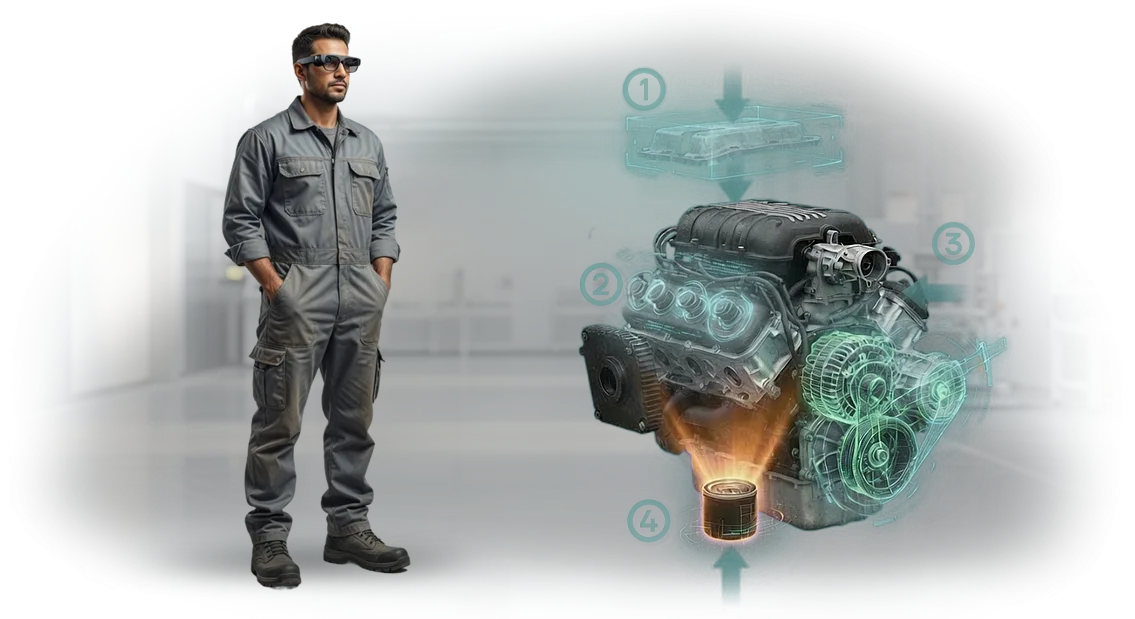
Replace bulky manuals and verbal knowledge transfer with AR instructions. Digital prompts appear right in the specialist's field of view overlaid on real equipment — they see where to point the tool, how much torque to apply, and which step was missed.
This reduces the defect rate and shortens the onboarding time for a new hire from weeks to a couple of days. Experienced employees stop being the bottleneck of production: their knowledge becomes systematic company capital instead of staying locked in one person's head.
This approach pays off quickly: fewer reworks, consistent batch quality, and automatic confirmation that the specialist actually completed every step. For medical equipment manufacturing, this is not just convenience — it is a manageable risk reduction process.
What AR instructions will give your plant
Every minute of downtime in medical equipment production costs the company money, and every employee error can turn into a rejected batch.
AR instructions solve this problem right at the workstation: instead of thick manuals, the operator or repair technician sees prompts overlaid on the real machine or assembly.
They don't need to remember anything, search through paperwork, or ask colleagues — the system shows the next step, the required tool, and the correct sequence of actions.
Maintenance and repair speed increases because time spent searching for information drops to zero. Employees don't flip through manuals — they immediately perform the operation, so equipment downtime is reduced significantly.
For the plant, this translates directly into output numbers: fewer pauses, more finished products, and a stable production plan.
Quality also reaches a new level. AR instructions standardize every process — everyone works to the same standard rather than relying on personal experience. Errors caused by human factors disappear, and the defect rate drops.
For the medical field, where precision requirements are especially high, such predictability means both customer trust and minimal losses from rework.
Knowledge deserves a separate mention. Experienced setup technicians and process engineers eventually leave, and the expertise accumulated over years goes with them.
AR instructions turn personal experience into a systematic company asset: best practices are captured, digitized, and remain available to everyone — from newcomer to veteran.
A new employee reaches full working speed faster, and the plant stops depending on "irreplaceable" specialists. Ultimately, you get not just a convenient tool, but a managed knowledge base that works for your results every day.
AR instruction formats for different tasks
In medical equipment production, mistakes are expensive: every incorrect operation is a risk for the patient and causes line downtime. Employees work in gloves, often in sterile zones, where paper manuals are inconvenient and a tablet has to be held in one hand. AR instructions solve this problem, but one format does not fit all scenarios.
We develop formats for the specific task — from step-by-step assembly prompts to a remote assistant that connects an expert to the operator's screen. Below are the standard options and what they deliver to your production.
| Format | Who it is for | What the client gets |
|---|---|---|
| Step-by-step instructions | Assembly line operators, employees performing routine operations | Fewer errors, faster ramp-up, less scrap and rework |
| Diagnostic instructions | Maintenance engineers and service teams | Fast fault identification, reduced downtime, clear inspection procedures |
| Training modules | New employees, training centers | Shorter onboarding, standardized skills, less burden on mentors |
| Remote assistant | Shop floor staff and an off-site expert | Instant consultation without site visits, recording of error reviews |
We will match a format to your process and demonstrate it on real equipment — request a demo.
How AR instructions are implemented at a factory
Implementing AR instructions is not buying a "boxed" application but a structured project that progresses from studying your production to full support. We accompany you at every stage so the result is predictable and employees quickly accept the technology.
Stages of AR instruction implementation
-
Brief and production audit. We meet with your team and study the operations where errors, downtime, or training difficulties most often occur. We define specific goals: reduce onboarding time, speed up repairs, or lower the defect rate. We record expectations and success criteria.
-
Project plan and prototype. We select an area for the pilot, develop AR instruction scenarios, and show a demo version on your equipment. You see how an employee will receive prompts and can make edits before full development begins.
-
Development and content creation. We create step-by-step instructions with 3D models, animations, and voice prompts. We integrate them with your technical documentation and training system. All materials remain with you and are easy to update.
-
Pilot launch. We deploy AR instructions in one area and involve real employees. We collect feedback: what is inconvenient, where clarification is needed. We adjust the scenarios so the tool truly works in your conditions.
-
Full rollout. We launch the system across all selected areas and train staff and supervisors. We configure access via tablets or AR glasses — employees simply put on the device and follow the prompts.
-
Support and development. We analyze how often the instructions are used and where questions arise. We update content when equipment or regulations change. If necessary, we scale the solution to new operations and lines.
This sequence allows you to launch AR instructions within a few weeks of the brief, with minimal disruption to production. You get not "technology for technology's sake," but a working tool that pays for itself through reduced errors and faster employee performance.
What is included in the AR instruction delivery package
The delivery package is not just an app and files. You receive a complete turnkey solution: content, software, training, and support. Everything is adapted to your regulations and specific equipment, so implementation takes days, not months.
The standard package includes:
- AR manual for your assemblies and operations: step-by-step scenarios, 3D prompts, and animations. The employee sees on the tablet screen how to perform the operation — no need to flip through paper manuals.
- App for smartphones and tablets — works offline on standard devices and requires no special training. Employees start using it on day one.
- Administrative panel — you independently update scenarios, add new regulations, and edit instructions without developer involvement.
- Employee training — we conduct training for operators and administrators and provide templates and cheat sheets. The team works confidently from day one.
- Technical support and guarantees — fixed launch timelines, updates during the warranty period, and support after handover. If equipment or regulations change — you are never left alone with the task.
This package addresses the main need of medical equipment production: reduce training time and lower the risk of errors when servicing equipment.
Case study: how we reduced downtime and errors at a factory
We worked with the oxygen concentrator manufacturer OxyMed: at the factory, every line requires more than a hundred operations, and this is exactly where the main losses occurred.
Operators spent up to 15% of each shift searching for the right diagram, and when assembling complex modules they made errors that only surfaced during quality control. Rework of defective products disrupted the shipping schedule, and new employees had to be trained for weeks.
We converted assembly operations to augmented reality: step-by-step instructions are projected directly onto the equipment, highlight the relevant components, and log every action.
The operator does not need to look away at paper documents — all information is right in front of them, and the system warns if an operation is performed incorrectly. Implementation took two months and did not stop production.
What changed after launching AR instructions: line downtime decreased by approximately 40%, assembly errors were cut in half, and the time for a new operator to reach full speed was halved. Operations that previously took 15 minutes are now completed in 10.
The factory was able to increase output without additional hiring — that is the main business result of the case.
The client has already scaled the solution to a second assembly line and plans to move the entire shop to AR instructions. The share of products passing quality control on the first attempt reached 98%, and average assembly speed is consistently higher than before implementation.
For us, this confirms: a properly built AR instruction is not an experiment, but a working tool for reducing costs and increasing production speed.
How to choose the right AR instruction format for production?
Choosing an AR instruction format starts not with technology, but with the production problem you want to solve.
If employees need to quickly learn to assemble a new unit — step-by-step overlays on the equipment will suffice, where each step is highlighted directly in the field of view.
If the focus is diagnostics and repair — you will need a remote expert mode where the specialist sees what the operator sees and provides voice guidance. For quality control, AR checklists with automatic verification of key parameters are more suitable.
The format selection criteria are the conditions at your production site: operation complexity, personnel skill level, and the need to work in gloves, noise, or limited lighting.
For example, projection-based prompts work well on a clean assembly table, while tablets or protective industrial glasses are better for harsh environments.
The higher the specialist's qualification, the more concise the instructions can be — the system can simply flag a deviation rather than guide the employee by the hand.
The second important criterion is how quickly instructions can be updated. In medical equipment production, regulations change frequently, and reprinting paper manuals means lost days and the risk of errors.
AR instructions are updated centrally: you change the content once, and all employees see the current version on their devices. This directly affects the speed of launching new products and the quality of assembly.
Finally, assess whether you need integration with your ERP or MES system. If you need to track who performed an operation and when, or collect cycle time statistics, choose a format that integrates with your accounting system and feeds data into it.
We help you select the right AR format for your tasks with an audit: we visit your production site, review the processes, and propose a pilot option that can be quickly tested in one area. This way, you get a working tool, not an abstract technology.
Frequently asked questions about AR instructions for factories
Many companies looking at AR instructions for the first time ask the same questions: will it damage the equipment, how difficult is implementation, and when will the first results appear.
Below, we address the most common concerns — briefly and to the point, from the perspective of your production and your team.
Will an AR instruction damage expensive medical equipment?
No. The AR system does not connect directly to machines or devices and does not interfere with their operation. The employee sees the prompts through a tablet or glasses, while the equipment itself continues to run in its normal mode.
It is like an electronic document with images overlaid on a real object — there is no risk to mechanics or electronics.
This is especially important for medical device production: you do not stop the lines or change processes — you simply give operators a clearer visual prompt.
Is it difficult to implement AR instructions if we already have our own regulations and documentation?
Implementation is designed to integrate with your current processes, not to disrupt them. We use your existing instructions and technical maps as the foundation, convert them into a visual format, and link them to specific operations.
Employee training takes a few hours — they do not need to understand the technology; they just need to repeat familiar actions following the prompts.
There is no need to change the production cycle: AR works as an additional layer of control and assistance at the workstation.
How long does it take to launch such a system in production?
It all depends on the number of operations and the level of detail. As a rule, the first pilot scenarios for one line are launched within a few weeks. You see the effect immediately, and scaling to other areas happens gradually, without stopping the main production.
At every stage, we align on interim results so you maintain control over timelines and quality.
How do AR instructions help train new employees?
Instead of thick folders and long lectures, a new employee sees step-by-step prompts directly on the equipment. They don't need to memorize everything at once: the system highlights the required component, shows the sequence of actions, and verifies the correctness of each step. Errors decrease from the very first days, and training takes noticeably less time.
For medical equipment production, this also means a unified quality standard: every operator follows one approved procedure, regardless of experience.
What about warranty and support after launch?
We support the project after implementation: we help update scenarios, add new operations, and adapt instructions when regulations change. You are never left alone with the system — a dedicated specialist is assigned to you who answers questions and quickly resolves issues.
This approach has already been proven in projects across different manufacturing sectors. Repeat orders and client recommendations speak for themselves: we are trusted as a reliable partner, not just a contractor.
Ready to discuss your project? Submit a request
Submit a request — and within 1 business day, we will prepare a proposal for your specific task. We will explain how AR instructions will reduce employee training time and lower the risk of errors when working with medical equipment.
What you receive after contacting us:
- Preliminary cost calculation — tailored to your production format and number of instructions.
- Consultation with an engineer and process specialist — we will help you choose the scenario that pays off fastest.
- Pilot project plan — test the AR instruction on one unit or operation before full deployment.
- A sample approach for your equipment — we will show what the instruction will look like on a real example.
- A cost estimate with development timelines and stages — a transparent plan with no hidden work.
- Data protection — we work exclusively under a non-disclosure agreement, with no leaks into public databases.
The pilot project lets you evaluate the impact of AR instructions on a single operation: measure execution time, number of errors, and how quickly a new hire starts working independently.
If the result meets your expectations — we scale it across the entire equipment fleet and train your specialists to maintain the content on their own.
Call us or write via messenger — we will respond within one business day. Or simply leave a request on the page, and we will call you back at a convenient time. You can order AR instructions even for a test area — start small and evaluate the results with your own numbers.