

Staff errors in building materials manufacturing
Every hour of forced downtime in building materials manufacturing means lost revenue, missed delivery deadlines, and frayed management nerves.
Production line stoppages most often happen due to the human factor: an operator skipped a step, misjudged the condition of a component, or violated the process regulations. The system did not break on its own — it was brought down by staff actions or inaction.
The cause goes deeper than simple inattention. Traditional process instructions — dense texts, diagrams, and tables — work poorly in stressful situations and under time pressure.
A newcomer needs weeks to act confidently without prompts, while an experienced employee loses minutes searching for the right section in a paper folder or at the tail of outdated regulations.
The result is operator errors, retraining of personnel, and emergency shutdowns that could have been avoided.
Business pays for this twice: first the costs of fixing the consequences and repairs, then losses from equipment downtime. The more complex the production line, the higher the price of every mistake.
At the same time, it is impossible to control quality "manually" — a person on the production floor always remains a person, and outdated instructions only increase the risk.
The solution lies not in tightening control, but in replacing ineffective instructions with live prompts that appear right before the operator's eyes at the exact moment they are needed.
Such systems reduce the number of abnormal situations, accelerate training of new employees, and turn downtime back into working time. This is exactly what we implement at enterprises producing building materials.
What benefits do AR instructions bring to a plant
At a building materials plant, every line stop is a direct loss, and an operator error can result in a whole batch being rejected.
Traditional paper and screen instructions do not help: an employee spends time searching for the right section, gets distracted from the equipment, and remembers only part of the algorithm.
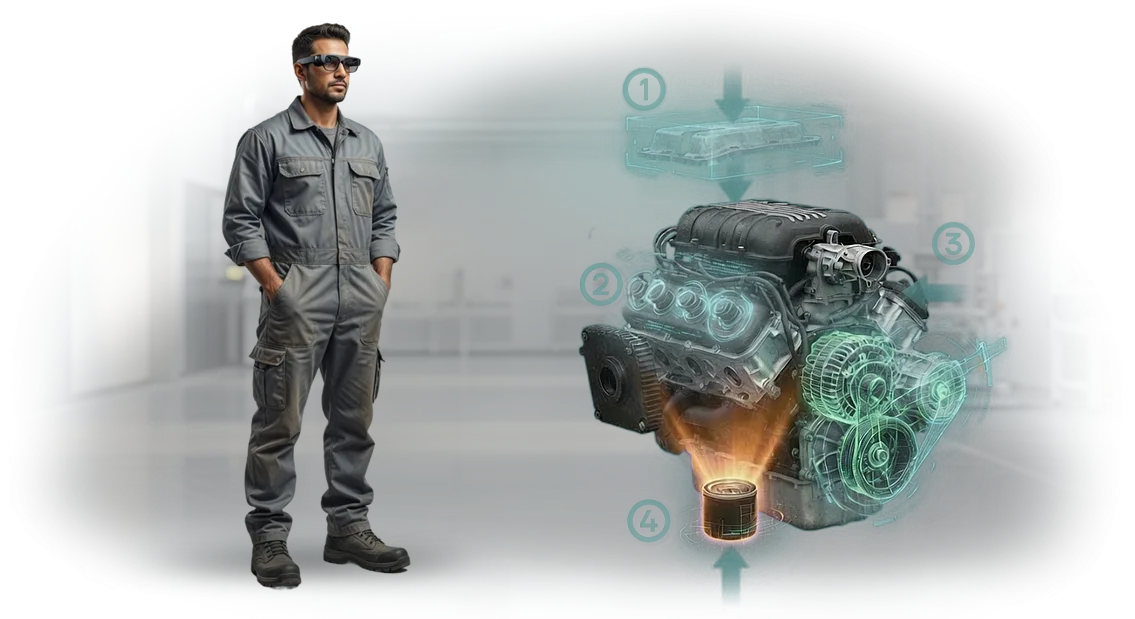
AR instructions overlay prompts directly onto the equipment — the worker sees the sequence of actions without looking away from the task.
We have been implementing such solutions for building materials production for more than 10 years. Below are the specific results a plant gets after launching AR instructions.
Check which effects matter for your production:
- Fewer staff errors. Step-by-step visualization eliminates the "human factor": the operator will not skip an operation or mix up the order of actions.
- Faster training for newcomers. A new employee reaches full productivity 2–3 times faster: no need to study hundreds of pages of instructions or memorize algorithms.
- Fewer accidents and less downtime. The system highlights hazard zones and warns about incorrect actions before they lead to breakdowns or injuries.
- Faster equipment commissioning. Setup and startup of a new line take less time: the specialist sees all components and fastenings through AR prompts instead of searching for them in drawings.
- Rapid payback. By reducing defects, downtime, and training costs, the project pays back within one production cycle. Savings are visible within the first month.
Each item is a measurable metric: number of errors, time per operation, number of incidents. After implementation, we measure "before" and "after" and show you the real effect in numbers, not promises.
If you would like, we will send you an example payback calculation for your type of production — just request a commercial proposal.
AR instruction formats for building materials plants
For a building materials manufacturer, augmented reality is a way to reduce downtime and lower the number of staff errors.
The media format should be matched to the specific task: it is one thing for an operator on the line to get a quick prompt, and another to guide a technologist through a complex procedure.
Augmented reality formats for plant tasks
Below is a comparison of the three main formats we use for building materials plants. Each solves its own business task: speeding up work, quality control, or remote assistance.
| Format | Who and what tasks it is for | What it gives the customer |
|---|---|---|
| Mobile AR applications | Line personnel, quick component checks, step-by-step prompts at the workstation | Fewer errors during assembly and maintenance, the employee does not re-read paper instructions |
| Tablets for technologists | Complex procedures, equipment setup, interactive guides and diagrams | Fast diagnostics without stopping the line, a single work standard for the whole shift |
| AR helmets and glasses | Repair crews, remote support, hard-to-reach places | Hands are free — repairs are faster and safer, no need to call an expert to the site |
The main selection principle is minimal time to obtain information. If an operator only needs a phone, glasses are unnecessary; if a technologist is working on a complex assembly, a tablet with detailed overlay will be more effective.
We help choose the format after an audit of workstations and determine where AR really reduces costs and where a regular instruction is enough.
How AR instruction development works
Predictability and implementation timelines are critical for building materials production. That is why the AR instruction development stages are structured so that the customer controls the result at every stage — from the brief to post-launch support.
-
AR brief. We study the equipment, documentation, and regulations. Together we determine where AR instructions will deliver quick results: training new employees, setup, repairs, or quality control.
-
Prototype and layout approval. On one component, we show how AR diagrams and labels overlay the real equipment. You approve the style, information composition, and step logic before mass development.
-
Scenario and content development. We prepare step-by-step animations, 3D models, and text prompts. Each scenario is tested on operating equipment so that the sequence of operations exactly matches the practice in your workshop.
-
Testing with your technologists. We hand over a pilot version for verification — engineers and technologists go through the instruction at their own workstations. We collect feedback, refine the wording and visualization, and make corrections.
-
Pilot launch. We implement AR on one site or one line. We train personnel, measure operation times, error counts, and employee feedback. Based on the results, we adjust the scenarios before scaling.
-
Post-launch support. We roll out the solution across the entire enterprise and integrate it with the accounting system. We provide ongoing support: updating instructions when regulations or equipment change, plus technical support for your team.
What's included in the AR instruction delivery package
For a plant, this is a complete package, not a set of semi-finished products: everything needed to launch AR instructions is delivered at once and "turnkey." Nothing needs to be refined by your own IT department — we implement, train the personnel, and crews start working from day one.
The delivery package includes:
- Project scope and work regulations — we fix the list of operations, deadlines, and responsible parties in the contract so you see the full implementation picture.
- Software package with license — employee workstations and a tool for updating content on your own.
- AR content for your equipment — step-by-step instructions for typical operations: setup, component replacement, troubleshooting.
- Employee training — hands-on sessions for operators and setup technicians so the system is used without interrupting production.
- Operating documentation — work regulations, instruction update procedures, and answers to frequently asked questions.
Importantly, the license is not tied to a single specialist: you decide who gets access, and when personnel change, the rights are reassigned within minutes.
The customer receives not just separate files and programs, but a working system with a trained team — and immediately reduces equipment downtime and the time needed to bring new employees up to speed.
Case study: how we reduced downtime at a plant
For a building materials plant, every hour of downtime is an undelivered batch, a shifted schedule, and broken commitments. When equipment stops, an engineer has to find the instruction, figure out the diagram, and wait for a specialist — this takes hours.
We set out to eliminate these losses with AR instructions, and here is what happened on a real project.
Implementation case study
A building materials manufacturer approached us: frequent breakdowns on the packaging line caused 3-4 hours of downtime per week. Personnel made errors when setting up components because the printed instruction was bulky and the diagrams were not visual.
We developed AR instructions for five types of regular operations: filter replacement, sensor calibration, tooling change, conveyor diagnostics, and scheduled maintenance.
A worker points a tablet at the equipment and sees a step-by-step prompt right on the parts: what to unscrew, in what order to remove, where to press. This made it possible to carry out repairs with line personnel without waiting for a visiting engineer. Below are the comparative results before and after implementation.
| Metric | Before implementation | After implementation |
|---|---|---|
| Average diagnostics time | 40 minutes | 12 minutes |
| Repair errors | 3-4 per month | almost eliminated |
| Line downtime due to breakdown | 3-4 hours | up to 1 hour |
As a result, line downtime fell by 30% in the first quarter, and repeat breakdowns caused by incorrect assembly practically disappeared. The engineering department stopped spending time on routine call-outs and moved on to modernization.
Client testimonial
The Technical Director of the plant confirms the result: "Previously, a simple filter replacement took more than an hour because the worker was flipping through a paper instruction and waiting for guidance.
Now the operator handles it in 15 minutes without an engineer. We really saw the effect in the shipment schedule. We are planning to expand the project to other areas."
This case shows: AR instructions pay off not through an abstract "tech-savvy image," but through concrete hours of equipment uptime. If you want to calculate the effect for your production — we will send a preliminary estimate based on your regulations.
Frequently asked questions about AR instruction implementation
Implementing AR instructions in building materials production is a step that raises many questions among managers. We answer the main ones, drawing on experience from projects for precast concrete plants, brick and cement lines.
We have been developing AR assistants for more than 10 years and know what matters for production.
Is it safe to use AR instructions on the production floor?
Yes, all instructions are checked for compliance with occupational safety requirements. The system does not interfere with machine control — it only shows prompts in the operator's field of view.
Data is transmitted over a secure corporate channel, so regulations stay within the plant's perimeter.
What equipment are AR instructions compatible with?
We adapt them to your machinery — from mixers and presses to packaging lines. The instructions run on tablets and industrial AR glasses that withstand dust, vibration, and temperature fluctuations.
No need to replace equipment: we use the existing control system or convert paper regulations into digital format.
How much time does personnel training take?
Usually from two hours to one working day. The operator sees prompts directly in the field of view, so it is enough to know how to follow arrows and step numbers. Our specialists conduct training on-site or remotely — whichever is more convenient for you.
What are the implementation timelines?
A pilot project takes 2-4 weeks; a standard solution takes up to 2 months. At the start, we create a detailed schedule with control points so you can see progress. We synchronize implementation with planned equipment stops — this reduces downtime.
How much does development cost?
The cost depends on the number of instructions, operation types, and required equipment. We prepare a transparent cost estimate after an audit, and payment is split into stages.
The project pays back through reduced defects, less downtime, and faster onboarding of new employees.
Still have questions about your site? Write to us — we will send an example instruction and give you an idea of timelines and cost for your production.Submit a request for AR instruction development
Submit a request — and we will contact you within one business day to discuss the task and propose options for implementing AR instructions at your production facility.
No obligations: first you receive a consultation and calculation, and you make the decision after you see the result on real operations.
After your inquiry, you receive:
- Cost calculation for development tailored to your equipment type and specific operations — from assembly of components to scheduled maintenance.
- Consultation on format — voice prompts, step-by-step 3D models, or critical point checks — we will advise what is more effective for your tasks.
- Demo access to an example AR instruction — open it on your smartphone or tablet and see how easy it is to work with the prompts.
- Pilot project — we implement the solution on one site so you can measure the effect on real tasks: operation time, number of errors, speed of training new employees.
- Implementation and operator training plan — we outline the steps, timelines, and equipment needs so the launch happens without stopping production.
- Answers to compatibility questions — we will clarify which devices suit your equipment fleet and how to integrate the instructions into existing processes.
If you are still unsure, start with a pilot project: it will show measurable benefits — reduced assembly time, fewer stoppages, and quick onboarding of newcomers.
To order an AR instruction, submit a request on the website or write to us in a messenger. In your message, specify the equipment type and the task — an engineer will contact you, clarify the details, and propose the optimal solution.
How to choose the right AR instruction format?
Choosing an AR format starts not with technology, but with the question: what exactly do you want to speed up or simplify on the production floor?
If the task is to train a new employee to work on the line without taking an experienced master away from their duties, a step-by-step mode with prompts overlaid on the equipment will work.
If you need an engineer on-site to receive real-time help from a remote expert — that is a different tool, with video communication and on-screen markers. There is no "one best" solution — only the right one for your situation.
We help you decide based on three criteria: the complexity of the operations, the number of employees who will use the instruction, and the conditions on the site — noise, dust, lighting.
The format depends on this: short visual prompts, augmented reality with equipment recognition, or a mixed option with video instructions and checkpoints.
During the consultation stage, we ask clarifying questions, look at the real process, and propose a solution that fits into your current workflow without restructuring the production cycle.
The other side also matters — what you get after implementation. One format reduces the time for a newcomer to reach independent work, another reduces the number of repair errors, and a third allows faster response to abnormal situations.
We compare options by launch time, convenience for your employees, and how the instruction will be updated when regulations change. We keep the technical details behind the scenes — you see only clear metrics and the benefit for production.
If you are unsure which format suits you — there is no need to dig into AR development. A short consultation is enough: tell us about the operation that causes the most problems, and we will match an option to your tasks.
As a result, you get a solution people use on the site every day, not a demonstration prototype. Submit a request, and we will help you choose an AR instruction that will pay off at your building materials production.