

Why transformer manufacturers lose up to 30% of time to repairs
Equipment downtime is the most expensive cost item in transformer manufacturing. Every hour of downtime means an unmet production plan, shipment delays, and strained relations with the customer.
At the same time, a significant portion of time is lost not on the repair itself, but on finding the right documentation and matching diagrams against the actual equipment.
Instructions in paper or PDF form become outdated faster than they are updated. A technician spends 20–30 minutes checking the product passport against the actual configuration, verifying tolerances, and figuring out which modification is in front of them.
On modern transformers, the design changes from batch to batch — and these differences rarely make it into the general instructions.
Transformer repair usually depends on one or two key specialists, and their experience leaves with them. When such an employee is on sick leave or vacation, a less prepared person takes over: works slower, hesitates more often, and is more likely to make mistakes.
An error in assembling the active part results in reopening the tank and additional days of downtime.
Personnel training also takes weeks. For a new employee to work confidently with the winding and cooling system, they need a mentor and access to real equipment — but while they are learning, production does not get full value from them.
Delicate operations such as torque control or insulation checks remain a risk zone without visual guidance.
Losses accumulate quietly: it took a little longer to find a diagram, the discrepancy was noticed a little later, and the solution took a little longer to agree on. Altogether this reaches 30% of the repair crew's time — this is exactly the figure we see at industrial sites.
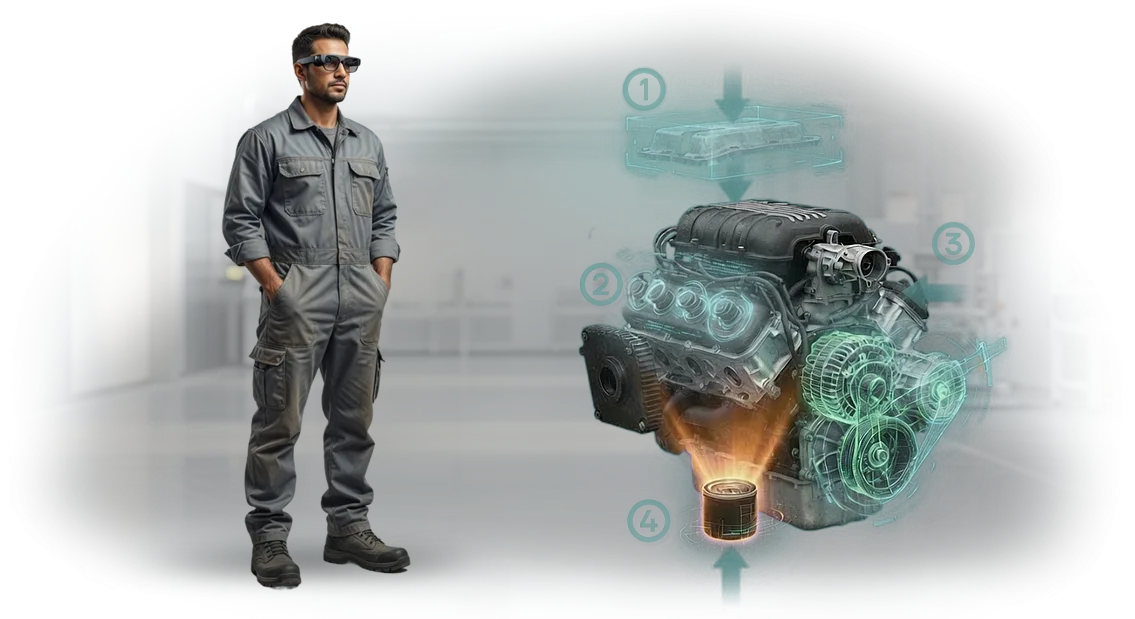
AR instructions address this pain point: hints are overlaid directly on the equipment, eliminating paper searches and reducing onboarding time. How this works in transformer manufacturing is covered below.
What an AR instruction delivers: faster repairs and fewer errors
Transformer repair is a race against time: every hour of downtime delays shipments and hits the production plan.
The crew pages through bulky regulations, searches for the right diagram, double-checks the sequence of operations — all of this is minutes that add up to hours, plus the risk of errors. An AR instruction solves both problems at once.
Repair speed
Instead of searching through paper, the specialist sees step-by-step hints directly on the equipment: what to remove, where to connect, how to check. There is no need to get distracted and re-read — hands stay busy while the instruction is always in view.
As a result, repairs take less time, and the crew manages to service more equipment units per shift. For a manager, this means a predictable schedule, fewer missed deadlines, and calmer negotiations with the customer.
Fewer errors and quality control
Each step in the AR instruction is logged, and the system will not allow moving to the next step until the previous action is completed. This prevents important operations from being skipped — such as incorrect tightening or a forgotten insulation check.
The manager can see what stage each job is at and can control quality without constantly being present on the floor. Less scrap means fewer repeat repairs and fewer customer complaints.
Work safety
The instruction warns about dangerous areas in advance and reminds about protection: where high voltage is present, where dielectric gloves are required, and what the de-energizing sequence looks like.
This reduces the risk of injuries and associated downtime, as well as complaints from the occupational safety department.
We build such instructions on industrial AR platforms, so they work reliably even in workshop conditions.
Hints do not "freeze" or slow the crew down — the result is predictable, and repair quality does not depend on the experience of a particular employee.
AR instruction formats for transformer manufacturing
In transformer manufacturing, one instruction does not fit all tasks. A beginner needs step-by-step training, a repair technician needs quick access to the right components, a process engineer needs help in non-standard situations.
The AR instruction format determines how quickly an employee gets information and how many errors they make at work.
The difference between formats is not in technology but in the result: how quickly the operation is mastered, how accurate the repair will be, and whether the section can run without downtime.
A properly chosen format reduces onboarding time and shortens equipment stoppages. We use three main options depending on the business task.
| Format | Scenario it suits | What the customer gets |
|---|---|---|
| Step-by-step AR instructions | Training operators to work with transformers | The employee sees hints directly on the mechanisms — masters operations faster and makes fewer mistakes during assembly and setup |
| Interactive diagrams with component highlighting | Equipment repair and maintenance | The service engineer quickly finds the faulty component and sees the disassembly and replacement sequence — repairs take less time |
| Remote AR support | Process engineer or external expert assistance on the line | The specialist sees the same as the employee on the floor and advises in real time — no need to wait for a site visit or stop production |
The formats are easy to combine: start with step-by-step training, then use interactive diagrams for repairs, and add remote support for complex cases. This works at facilities with high safety and quality requirements.
During a consultation, we select the optimal format for the specific stage of personnel work and the type of equipment.
How AR implementation works at your facility
Implementing AR in transformer manufacturing does not require stopping the workshop or replacing equipment.
It is a new support layer that overlays current operations and makes them clearer for employees: hints are visible directly on the components, and there is no need to page through paper regulations.
Our team has carried out dozens of such implementations at industrial sites, so you get not an experiment but a proven process. So you know in advance what you will get and when, the project goes through clear stages — from brief to post-launch support.
How we structure the project
- Brief and site audit. We visit the production site, study real operations in the transformer assembly area, and collect questions from process engineers and operators.
- Site selection and pilot project. Together we identify where AR will deliver quick value and launch a pilot on a limited number of operations — usually for 2–4 weeks.
- AR instruction development. Based on your documentation and videos of real operations, we create step-by-step hints that the employee sees right in the workshop.
- Testing and revisions. We show the prototype to operators and supervisors, collect feedback, and refine the instruction to a convenient state before scaling.
- Workshop integration. We configure employee access, connect to your accounting system if needed, and verify operation under real shift conditions.
- Launch and support. We bring instructions into daily work, train personnel, and update content when regulations change.
At each stage, you get concrete results and dates. A pilot usually takes up to a month, full implementation up to two months. This way you see the effect already at the pilot stage and make a scaling decision based on numbers, not promises.
What is included in the AR instruction delivery
An AR instruction is not just an "animated picture" but a working tool for your production. We specify the full delivery scope in the contract so that from day one you understand what you get and how to use it.
Below is the base package, which adapts to your tasks: transformer types, number of employees, and operation complexity.
- AR modules for key operations. Assembly, setup, diagnostics, and repair — step-by-step hints with voice comments and visual component highlighting. The employee sees the required actions directly on the equipment without being distracted by paper regulations.
- Technical documentation in digital form. Electrical diagrams, maintenance regulations, product passports — all collected in a single database and opened within the instruction. There is no risk of losing the current version.
- Administrative panel for updates. Make changes yourself: replaced a component or changed a regulation — the edit appears for all employees automatically. No requests to developers and no weeks of waiting.
- Training for your instructors. We prepare employees who will train the rest: how to use the AR instruction, update content, and keep the hints accurate.
- Support during implementation. We help integrate the instruction into the existing training and repair process and answer questions in the first weeks of operation.
- Corporate license. Use the instruction without restrictions inside the company: in all workshops, branches, and training centers. No hidden fees based on the number of devices or users.
The end result: you order not a one-time development but a system that reduces onboarding time, lowers the number of repair errors, and makes knowledge independent of "senior specialists." The specified delivery scope protects against misunderstandings and gives you a clear result already after the first implementation stage.
Case study: how we cut repair time by 40% at a plant
We develop AR instructions for industry, and a telling example is a project at a transformer manufacturing plant.
The customer had a classic pain point: repairing complex equipment took 6–8 hours because the most experienced engineer was in another city and the local crew lacked the knowledge. Every hour of downtime meant lost output, and calling in a specialist was expensive.
Instead of paper regulations and sending photos through messengers, we proposed an AR remote assistant system.
The operator points the tablet camera at the transformer component and sees a step-by-step instruction right on top of the equipment: what to unscrew, in what order, and what torque values are acceptable.
If the situation is non-standard, the engineer connects remotely and "draws" hints right in the employee's field of view.
Implementation result
The effect was felt by the finance director, not just the workshop. Average repair time dropped by 40%: from 8 hours to 4.8. Over a year, this returned more than 300 hours of production time to the plant.
In addition, setup efficiency improved — new employees began performing operations confidently after a couple of shifts instead of a month of internship.
The key point is reduced downtime without hiring new engineers. The customer used the same resources but with fewer losses. After the first project, they ordered two additional batches of instructions for other lines — the best indication that AR implementation pays off.
How to choose the right AR instruction format?
Choosing an AR instruction format starts not with technology but with the task: what exactly the employee should get at the machine or inside the transformer.
If the operation is standard and repeated daily — a step-by-step instruction with component highlighting and action checks is enough.
If non-standard situations arise that cannot be prepared for in advance, a remote assistant is more effective, where an expert sees the same as the worker and advises in real time.
Assess the frequency and complexity of operations. Rare but critical work — for example, transformer assembly or diagnostics — requires maximum detail and the ability to pause, return to a step, and record the result.
Frequent operations benefit from brevity: the employee needs quick access to the right component, not a re-read of the entire instruction. We select a format for your specific situation rather than offering a one-size-fits-all solution.
Consider working conditions and personnel qualifications.
In a workshop with high noise and dust levels, an AR interface with large elements and voice control is more convenient, and the instruction must work on professional tablets and headsets resistant to the production environment.
If employees are just getting familiar with digital tools, we focus on simplicity: minimal actions, large hints, automatic error checking.
The further lifecycle of the instruction also matters. If regulations change, choose a format that is easy to update without re-shooting or reprogramming.
We design AR solutions so that you can make edits to the text and step logic yourself, without involving developers each time. This reduces support time and guarantees that the instruction always meets current standards.
The ultimate criterion is measurable impact: reduced operation time, fewer errors, and speed of a newcomer achieving independent work. At the start, we audit your processes, identify bottlenecks, and offer 2-3 formats with a projected result.
By choosing the right option together with us, you get an instruction that works in production rather than remaining a demo stand.
Addressing common doubts: is AR hard to implement?
Production owners usually imagine AR implementation as a major construction project: workshops must be stopped, tooling replaced, and staff retrained for weeks.
In practice, AR instruction implementation runs in parallel with current processes: we adapt the system to your regulations and launch the first pilot areas within a few weeks.
Equipment requirements are also simpler than they seem. In most cases, tablets or smartphones that supervisors and process engineers already have are sufficient.
If the hardware is outdated, we will select a test kit — employees will see the result before purchasing rather than after.
A separate question is occupational safety. AR does not distract the worker; on the contrary, it anchors hints directly on the equipment: no need to page through paper instructions or memorize sequences. This reduces the risk of errors and makes safety compliance a natural part of the job.
How long does a pilot project take?
The first area with AR instructions can be launched in 2–4 weeks: brief, filming operations, building scenarios, and training two or three supervisors. After that, we scale as regulations become ready.
What equipment will be needed on the production floor?
Tablets or smartphones with a camera are sufficient. We host the server side in your infrastructure or in a secure cloud — access remains with your IT department, and nothing goes to third-party contractors.
Will it conflict with occupational safety requirements?
AR instructions do not replace existing regulations but complement them. Hints appear on the device screen, the worker's hands remain free, and mandatory checks and work permits are preserved. If needed, an auditor gets a log of completed operations without stopping the process.
Leave a request — we will prepare an implementation plan for your facility
Leave a request for AR — and within two business days we will prepare an implementation plan for your facility.
It is important for us to see production through the eyes of your engineers: where assembly takes place, which operations are most critical, and where beginners make mistakes most often. Both the instruction set and the final cost depend on this.
An ideal brief is not needed to calculate the cost — a request from the site is enough. You then receive a short and clear plan: what we digitize, why, how quickly we implement, and what result it delivers to each crew.
After your request, we go through the following stages together:
- Request: you describe the task and attach photos/video of the site — that is enough to start.
- Engineer consultation: our specialist clarifies details, answers questions, and proposes an initial solution.
- Site audit: remotely or with a visit, we study the equipment, operations, and staff working conditions.
- Cost and timeline estimate: we lock in the scope of work, budget, and launch date — with no hidden surcharges.
- Implementation plan: a step-by-step scheme with areas of responsibility, control points, and acceptance stages.
- Support: after launch, we stay in touch — updating instructions when regulations or equipment change.
This way, an AR request turns into a clear project with a predictable outcome. You get not just a presentation but a working plan that can be immediately approved and handed over to production.