

How to reduce equipment downtime at solar energy facilities?
Every hour of downtime at a solar energy facility means more than just halted generation—it triggers a cascade of costs, from lost revenue to emergency logistics and contractor mobilization.
And when dozens or hundreds of inverters and tracker systems are involved, the cost of a mistake multiplies. At the same time, industrial equipment maintenance often still relies on paper procedures and outdated schematics that no longer match the station's actual configuration.
A technician spends hours searching for the right component, getting approvals for the sequence of actions, and waiting for guidance from a remote expert.
This is especially critical at modern solar facilities: equipment is constantly evolving, multiple generations of models operate side by side, and a single mistake can damage expensive components or cause prolonged downtime across the entire chain.
Putting this problem into numbers paints a sobering picture: up to 30% of staff working time goes to information searches and approvals, and downtime caused by human error is one of the biggest loss items for solar plant owners.
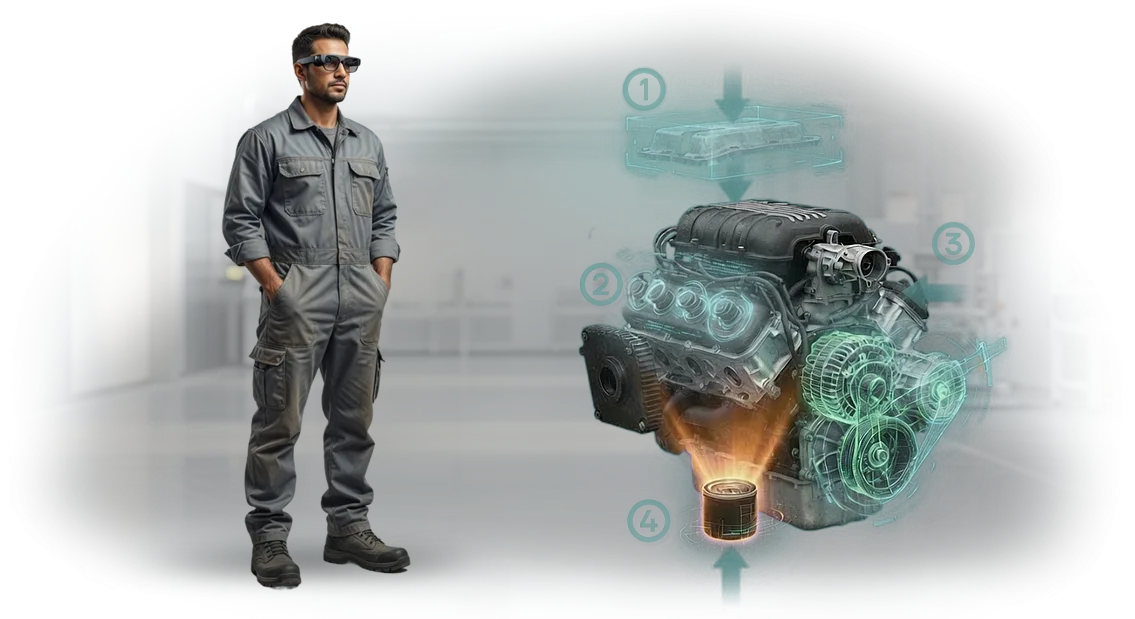
The solution is to digitize instructions and overlay them directly onto the equipment. This way, the employee sees the required component, the sequence of steps, and hazard warnings in real time—no more leafing through paper manuals.
This is exactly how we help owners and operators of solar power plants: we reduce industrial equipment maintenance time, lower the risk of errors, and make knowledge independent of any single employee's experience. Implementing AR instructions pays off quickly—just a few avoided prolonged downtimes are enough.
What implementing AR instructions will give your team
In solar energy, every hour of downtime means lost output and missed deadlines. A mistake during installation or configuration is expensive.
AR instructions solve both problems: the employee sees step-by-step guidance right on the equipment and doesn't waste time searching for procedures.
Speed of response to abnormal situations
The technician no longer flips through multi-volume manuals: the required diagram and sequence of actions appear directly on the real component. Diagnostics take minutes instead of hours, and the facility returns to operation faster.
This is especially important for remote solar power plants—crews often work autonomously. A quick response to a system signal directly protects generation output and contract deadlines.
Fewer errors during installation and maintenance
The AR instruction shows the sequence of steps, highlights danger zones, and verifies the correctness of each action. The employee gets feedback immediately, without waiting for a supervisor's inspection.
The number of reworks and repeat site visits drops sharply, and the station operates reliably from day one. The company saves on warranty service.
Reduced staff training costs
A newcomer doesn't need to spend months shadowing a mentor: the system guides them step by step and suggests what to do next. Time-to-competency is reduced several times over.
The expertise of the best specialists is captured in AR scenarios and can be replicated across any crew. Training becomes standardized, and the company no longer depends on staff turnover.
AR instruction formats for solar energy tasks
In solar energy, tasks vary widely: one thing is urgently fixing a fault at a remote station, another is training new employees or performing a routine panel inspection. A one-size-fits-all instruction won't work here—you need a format tailored to the specific scenario.
We develop AR instructions in several formats, each addressing its own task and delivering a measurable result: less downtime, faster training, higher quality of work.
Main formats for solar energy tasks
| Format | For whom | What it delivers for the client |
|---|---|---|
| Remote assistant | On-site engineer, technical specialist | Instant expert connection: the expert sees exactly what the employee sees and provides guidance right in their field of view. The engineer doesn't wait for a site visit—the issue is resolved within minutes. |
| Personnel training | New employees, contractor crews | Fast onboarding: trainees run scenarios in augmented reality without distracting experienced mentors. Knowledge is absorbed through hands-on practice, not reading instructions. |
| Planned maintenance | Service crews, operations departments | Step-by-step inspection and maintenance scenarios for panels and inverters. The sequence of actions and standards are always in front of the employee—no checklist item gets missed. |
| Acceptance and commissioning | Project teams, contractors | Visual verification that installation matches the project schematic. Errors are caught on the spot, not after launch. |
The formats combine easily: start with training, then use the remote assistant during the warranty period, and afterwards move to planned maintenance using ready-made scenarios. This approach reduces maintenance errors and speeds up routine operations without sacrificing quality. You choose the formats that fit your tasks, and we adapt them to your equipment and processes.
How we develop AR instructions: a step-by-step process
A clear process means a predictable result. We break the work into stages so you can see what happens at each step and when the product will be ready. Below is how we structure a project, from the first brief to post-launch support.
How the work proceeds
-
Brief and immersion into the task — You explain how equipment maintenance currently works and what difficulties your employees face. We ask questions, study your procedures, and identify which part of the process an AR instruction will cover best.
-
Audit of equipment and scenarios — Together with your specialists, we break down real operations: routine maintenance, repair, configuration. We record what needs to be shown visually and where errors most often occur. This becomes the foundation of the future scenario.
-
Development of an instruction prototype — We build the first version: digitize the parts, overlay guidance onto the camera feed, and create a step-by-step scenario. You get a working prototype and immediately see how the instruction will look on a tablet or phone.
-
Review and refinement — We show the prototype to your technologists and installers, gather feedback, and make adjustments. After each cycle, you see the changes and know exactly when the product will be ready.
-
On-site deployment — We install the system on your devices and, if needed, connect the remote assistant. We train employees: they can call up an instruction in seconds without searching for paper documents.
-
Support and development — After launch, we monitor performance, analyze usage, and update instructions when equipment or procedures change. You're never left alone with the system.
Each stage ends with a concrete result: a document, a prototype, a working version.
This is how we keep timelines under control and avoid situations where work is done "into the void." At the start, we state the overall duration and key milestones—you know in advance when you'll receive the completed AR instruction.
What's included in the AR solution delivery
For a client, repairing or routinely servicing a solar station means halted generation and disrupted schedules.
Every hour of equipment downtime means lost energy and contractual risks, so you need a complete working package, not a "raw application." The delivery includes:
- AR application — works on the tablets and smartphones your specialists already have. No additional equipment needed: point the camera at the inverter—and you get guidance right on the screen.
- Digital instructions — step-by-step scenarios for installation, commissioning, diagnostics, and repair. The employee sees where to connect a cable, which component to unscrew, and in what order to proceed—instead of flipping through paper procedures.
- 3D content and animations — detailed models of your equipment with annotated components and mechanisms. This helps newcomers understand the station's structure faster and reduces errors when working with complex systems.
- Content management dashboard — update instructions, add new components, and change procedures yourself, without developer involvement. Changes are immediately visible to all employees on their devices.
- Staff training — hands-on sessions for engineers and technical specialists: how to use the app, how to read the guidance, and what to do in abnormal situations.
- Technical support — we support the project after launch: answer employee questions, fix issues promptly, and help adapt instructions to new tasks. Guaranteed stable operation for the entire period of cooperation.
Case study: cutting downtime by 30% with AR
Unscheduled equipment stops at a solar station are expensive: every minute of downtime is lost energy generation. A specialist needs time to reach the site, find the fault, and explain the sequence of actions to the staff. During the repair, the station operates below full capacity.
We proposed AR instructions that overlay onto the equipment in real time. The operator sees step-by-step guidance right before their eyes: what to check, where to press, how to safely unlock the mechanism.
If the situation is unusual, a remote engineer connects—they see the same image and guide the operator immediately.
Over three months of the project, downtime dropped by 30%, and typical repair time was cut in half. Station staff began handling most tasks without an on-site expert.
After the pilot period, the client expanded the scenarios to other components and ordered training for new employees.
The station manager noted: "Previously, a specialist site visit took a full day; now help arrives within minutes. We see the result in the generation statistics" SolarEnergo.
This is exactly the case where the technology pays off quickly and doesn't require changing the entire production culture.
We don't just draw instructions—we design the process so that any operator can handle it. To do this, we analyze work scenarios, remove unnecessary steps, and add feedback from employees. This is how AR becomes part of daily work rather than just another experiment.
How to choose the right AR instruction format?
There is no universal AR instruction format—the choice depends on what task your team needs to solve. In solar energy, this could be onboarding new employees, routine panel maintenance, inverter diagnostics, or emergency fault resolution at a remote station.
The same facility may require different formats: from short on-screen prompts to full step-by-step guidance with verification of every action.
It's important to consider where exactly your specialist works. Solar stations are often out in the field, under open sun, in bright light and wind.
Therefore, AR guidance must not distract but help: large elements overlaid on the equipment, voice control, or an image that remains visible even through protective eyewear.
For routine operations, an interactive diagram with the required component highlighted is enough; for rare and complex operations, a full instruction with error control is better.
If you have engineers at remote sites, choose a format with a remote assistant: a specialist from the office sees exactly what the employee at the station sees and marks directly on the image where to look and what to unscrew. This format replaces endless phone conversations and cuts troubleshooting time several times over.
For training, a combined approach is safer: first practice on a simulator, then work on real equipment with guidance—this way the employee learns the procedure without stress or downtime.
To avoid picking formats blindly, start with a quick analysis. We review your procedures, listen to how the work is actually performed, and recommend the format that will deliver maximum impact.
For us, the goal is not technology for technology's sake, but saving your specialists' time and reducing the number of errors at your sites. We have already worked with companies in solar energy and helped simplify maintenance and equipment commissioning.
Submit a request on our website—we'll tell you which AR instructions suit your team specifically and what to pay attention to during implementation. After a short interview with your engineers, you'll receive a concrete recommendation within one business day.
Frequently asked questions about implementing AR instructions
Any new equipment raises questions, and AR instructions are no exception. Managers need to understand how reliable the system is, how quickly it will be deployed, and who is responsible for stability after launch.
This is especially critical in solar energy, where equipment downtime directly affects generation and revenue. Let's address the most common concern.
What happens if the AR system fails?
We operate on a full-support principle: we handle configuration, regular updates, and technical support. If something goes wrong, we resolve the issue remotely or send a replacement if needed.
The system itself runs on professional-grade equipment designed for intensive use in a workshop or outdoors—so failures are extremely rare.
Ready to get an AR solution for your enterprise?
You already know how AR instructions reduce downtime and the number of errors when servicing solar equipment. All that's left is the first step—discussing your task with our specialists.
We'll provide a consultation, show implementation examples, and offer a solution for your budget and timeline.
After you reach out, you'll receive:
- A consultation: we'll analyze your situation and point out where AR will deliver maximum impact—from panel installation to planned repairs.
- A demonstration of ready-made AR instructions for industrial equipment and solar energy facilities.
- An accurate estimate of timelines and development cost—calculated after audit, with no hidden fees or "surprises" along the way.
- A pilot project on one component or process, so you can verify the result before full deployment.
- A technical specification and integration plan aligned with your maintenance procedures and safety standards.
- Post-support: we'll update the content when your equipment or procedures change.
Ordering AR instructions is simple: write to us via the form on the website or contact us at the details in the header—we'll get back to you within a day with specific options. Start with a consultation and see that a modern solution is within reach for your enterprise.