

Shipbuilding Loses Money on Outdated Instructions
Shipbuilding is an industry where the cost of an error is especially high. Complex equipment, multi-stage operations, and strict quality requirements — any production failure results in expensive defects.
But the most vulnerable link often goes unnoticed: outdated operating instructions that don't keep up with reality.
Personnel are forced to spend time searching for the right section in thick paper manuals or relying on the experience of colleagues. As a result, the number of personnel errors grows, and equipment downtime becomes routine.
This is especially felt when onboarding new employees: their training takes weeks and months, while experienced mentors are distracted from their main work.
Each such error means not only lost hours, but also the risk of damage to expensive components, missed delivery deadlines, and additional repair costs. On the scale of a shipyard, losses add up to tens of hours of downtime and lost revenue.
What's more, paper becomes outdated the moment technology or equipment changes: making edits to such a document is slow and difficult, and monitoring that everyone works from the current version is practically impossible.
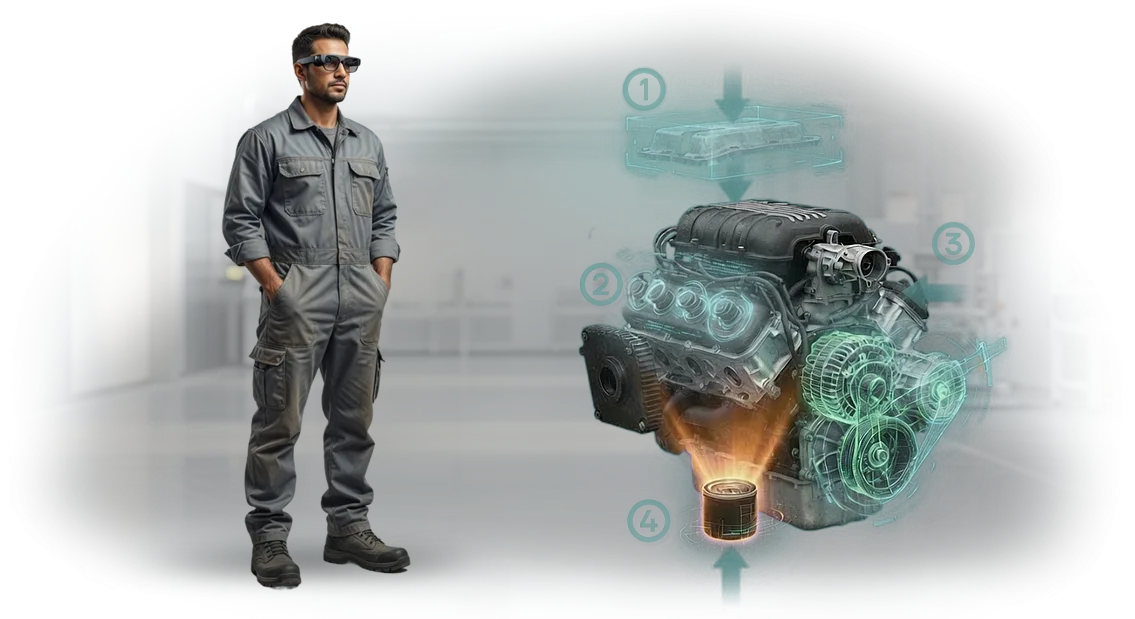
That's why shipbuilding enterprises are increasingly moving instructions into augmented reality. AR instructions overlay step-by-step prompts directly onto the equipment, and the operator sees the sequence of actions without being distracted by documentation searches.
This reduces training time, lowers the number of errors, and brings downtime hours back into the production schedule.
For managers, this means predictability: fewer defects, faster onboarding, higher process discipline. And the shift from paper to digital is no longer a headache — we handle the conversion and adaptation of instructions to the specific equipment and tasks of your shipyard. Shipbuilding gets a modern tool that pays for itself by reducing downtime and errors.
How AR Instructions Reduce Costs in Shipbuilding
Shipbuilding is an industry where the cost of an error is measured not only in materials, but also in order delivery deadlines. Complex assemblies, dozens of assembly stages, and high staff turnover force companies to spend months on training and constant supervision.
AR instructions move the process into a digital environment: workers see prompts directly on the equipment, without being distracted by drawings and paper regulations.
New employees master operations several times faster because the system guides them step by step and highlights the required tool or attachment point. This reduces onboarding time and eases the burden on mentors, who can focus on more complex tasks.
As a result, the production line reaches planned speed faster, and training costs stop growing in proportion to the number of new hires.
A separate benefit comes from reducing errors during assembly and repair. When instructions are overlaid onto the real object, workers less often skip operations and less often confuse the sequence of actions.
Fewer defects mean fewer reworks and write-offs — and that means direct savings and a predictable vessel delivery date.
Remote support solves the problem of scarce specialists. An engineer or technologist connects to a worker on site, sees their field of view through an AR headset, and gives instructions by voice or digital markers.
This eliminates business trips and long waits — issues are resolved in minutes, and expensive slipway downtime is reduced to zero.
In the end, AR instructions serve the entire production ecosystem: faster workforce training, fewer defects, prompt expert assistance, and higher overall efficiency.
The customer gets not just a technology, but a cost-reduction tool that pays for itself on the first vessels and continues to save resources on every subsequent keel laying.
AR Instruction Formats for Your Production Tasks
Each production task has its own conditions: assembly takes place in a workshop or on a slipway, maintenance in confined compartments, training in a classroom or right on the vessel.
That's why we don't impose a single template, but select the AR instruction format for the specific stage of the equipment lifecycle.
The table below shows typical formats already used in shipbuilding and ship repair.
| AR Instruction Format | Who It's For | Client Benefits |
|---|---|---|
| Step-by-Step AR Assembly | Assembly crews, commissioning engineers | Clear sequence of operations, key point monitoring, fewer errors and reworks |
| AR Service Maintenance Instruction | Service departments, duty engineers | Fast fault location, step-by-step procedures right in the field of view, protection against skipping important steps |
| Training AR Scenario | New employees, training centers | Accelerated training without a mentor, uniform standards across the shipyard, knowledge testing on a simulator |
| Remote AR Support | Engineers on the vessel, technologists ashore | Face-to-face problem solving with an expert, reduced downtime, fewer specialist site visits |
The format depends on where your employees work — in the workshop, on the vessel, or in the training classroom. We make sure the instruction appears exactly when it's needed, on the device the specialist already has.
How We Create AR Instructions: From Brief to Launch
We've structured the process so you see intermediate results at every stage and understand what you'll get in the end. No "magic": first we break down your production task, then we show a scenario, and only after your approval do we start work.
-
Brief and process audit. We meet with your team and identify exactly where time is lost and errors occur: assembly of complex components, maintenance of equipment, training of new employees.
We determine the areas where AR instructions will deliver measurable results — faster assembly, fewer defects, simpler knowledge transfer.
-
Scenario prototype on a real example. We take one operation from your production and create a demonstration AR instruction. You see how an employee will view the prompts and evaluate the usability before full development begins.
-
Content development for all operations. Based on the approved scenario, we create step-by-step instructions: visual 3D models, assembly animations, and checkpoints.
All content is adapted for the tablets or glasses personnel already use — without significant spending on new equipment.
-
Review and refinement. We show the finished instructions to your engineers and technologists. We collect feedback and make edits until everyone who will work with the system is satisfied.
-
Implementation in production. We train employees, set up access, and integrate AR instructions into workflows. We run a pilot at one site, verify the system works without failures, and then roll it out.
-
Support and development. After launch, we stay in touch: we update instructions when designs change, add new operations, and help your team make edits independently. You get a tool that lives and grows with your production.
Timelines and cost are fixed in the contract at the start — you know what you'll get and when. At every stage, you have the right to make adjustments so the final product precisely matches your tasks and the specifics of shipbuilding production.
What's Included in the AR Instruction Package
When you order AR instructions, you get not a "file for developers" but a complete delivery package. You can start working in the workshop or at the shipyard tomorrow: everything is already adapted to your equipment, regulations, and staff skill levels.
- Ready-made AR scenarios for typical operations — assembly, repair, quality control. An employee sees the sequence of actions right in their field of view and doesn't waste time reading drawings and paper instructions.
- Clear instructions for each scenario — short text and video cheat sheets. They're useful for training newcomers, accepting work, and certifying personnel.
- Operational documentation — scenario descriptions, startup procedures, and a change management process. You're not dependent on a specific vendor: any department in your company can figure out how everything works.
- Training for your employees — we conduct practical sessions after which your engineers and instructors can launch AR scenarios themselves and pass the skills on to others. Training follows your production standards.
- Technical support and updates — when equipment, regulations, or the set of operations changes, we make edits to the scenarios. Content stays current without a separate project cycle.
In the end, the package covers the entire implementation cycle: from the first day of use to regular operation with minimal load on your training department.
You get a tool that pays off on every operation — fewer errors, faster onboarding of newcomers, higher productivity at the shipyard.
Case Study: Reducing Downtime by 30% with AR Instructions
For a shipbuilding plant, every hour of dock downtime means missed vessel delivery deadlines, stalled adjacent workshops, and extra overtime costs.
Previously, repairing a complex unit took several shifts: a senior engineer personally passed on experience, and a single crew error led to a complete teardown.
Weimplemented AR instructions for repair operations. A specialist points the tablet camera at the unit — and sees prompts: which fasteners to remove, in what order to proceed, where the acceptable tolerances are.
The experience of the plant's best engineers becomes a step-by-step scenario available to everyone at the workbench.
What Changed After Three Months
Repair downtime dropped by 30%, and the average time for a single operation decreased by almost half. The number of errors that required reworking fell by 40% — and along with them went material overruns and extra overtime. The workshop budget felt the savings in the very first reporting period.
Why the Result Was Sustainable
It's not about the tablet itself, but about a properly structured scenario.
We combined the experience of the plant's repair crews with our augmented reality platform on professional equipment — the system works reliably in workshop conditions: with vibration, dust, and poor lighting, and workers master it in one day.
Now the plant uses AR instructions as the standard for training and repair. A manager sees in the control panel which operations take more time and plans preventive maintenance in advance — downtime isn't eliminated but prevented.
How to Choose the Right AR Instruction Format for Your Task?
An AR instruction format is never "correct" or "trendy" — it's either suitable for your production task or not. What works effectively for scheduled maintenance at a shipyard may not suit emergency repairs in the confined space of an engine room.
That's why the choice starts not with technology, but with a question: what exactly should your specialists do faster and more accurately?
Individual requirements play a decisive role: staff skill levels, working conditions (lighting, noise, protective gear), equipment complexity, and the criticality of each operation.
In shipbuilding, where different crews assemble the same system, it's important that the instruction guides a newcomer and an experienced master equally well.
We take this into account and offer not an abstract "AR solution," but a specific scenario: step-by-step control, voice prompts, or projection markers on components.
When selecting a format, we analyze your technological processes and the points where errors, downtime, or dependence on specialized experts occur.
After that, we offer 2–3 implementation options with different levels of immersion and discuss which one will deliver the greatest effect in your work rhythm.
Together with you, we define a pilot site, test the instruction on real operations, and then scale up based on the results.
The main thing is that you're not left alone with the choice. Our experience in industrial implementations allows us to design a format for your specifics, including integration with existing documentation and training.
You get not just a set of instructions, but a tool that measurably reduces the number of errors and speeds up commissioning. If you're unsure which option suits your production, start with a short task audit: we'll tell you what to pay attention to first.
Frequently Asked Questions About AR Instruction Development
Doubts before launching AR are normal: you're responsible for the safety and uninterrupted operation of shipboard equipment. Below are answers to the questions chief engineers and production directors ask most often. If your question isn't here, write to us — we'll show a demo on your equipment.
How long does AR instruction development take?
A typical project takes from two weeks to one and a half months. After a preliminary discussion, you receive a plan with intermediate demos, so the progress of work is transparent and predictable.
What does the cost depend on?
The cost depends on the number of scenarios and the scope of equipment, and is fixed in the contract after the task is clarified — with no hidden surcharges. These are investments that pay off through reduced downtime and errors.
Is it compatible with our old equipment?
Tablets or smartphones already available in the workshop are sufficient. The instruction adapts to your documentation and 3D models — even for machinery manufactured many years ago.
How difficult is it to implement AR and train personnel?
Training takes about an hour — the interface mirrors the logic of paper instructions. We train your instructor and support the launch for the first month.
What happens if an AR instruction fails?
You get a warranty on scenarios, remote diagnostics, and backup copies. The files remain stored on your side — in a critical moment, you're not dependent on us.
Order AR Instruction Development Today
Submit a request on our website, and we'll get back to you within one business day. Tell us about your tasks: which components and assemblies need instructions, how many employees work with regulations, and where errors most often occur.
We'll point out where AR will deliver quick results and estimate the scope of work. This is non-binding.
During the consultation, a technical specialist will analyze your process and answer practical questions: how augmented reality integrates into your existing maintenance system, whether new software is needed, and how to train personnel.
You'll understand what you're actually getting, not "in theory." After that, we'll prepare a commercial proposal with a transparent cost breakdown — what makes up the amount, what payment stages are possible, and what's included in each stage.
Along with the commercial proposal, you'll receive:
- A brief audit: which instructions are most beneficial to convert to AR first — based on frequency of use and impact on downtime.
- A timeline estimate: from the first brief to a working prototype at one site.
- A pilot implementation plan with clear metrics: training time, number of errors, speed of operations.
- Technical recommendations — based on experience in shipbuilding and heavy machinery.
- Clear engagement formats: fixed cost or staged payment with acceptance at each step.
Submit your request today — tomorrow you'll have the full picture of the project. Start with a consultation, and make your decision based on the results.