

Why Do Telecommunications Incur Losses from Prolonged Repairs?
In telecommunications, equipment downtime is not just a technical hiccup — it is a direct loss of revenue and customer trust. While the network is down, operators lose money, users experience disruptions, and large customers postpone launching new projects.
The problem is compounded by the fact that equipment repair almost always requires a rare specialist who is not on site when needed.
The expert who knows a specific system usually works in one city, while sites are scattered across the country or even abroad. Sending an expert on site means days of waiting, travel and accommodation costs, and a high hourly rate. But the main factor is time.
When equipment is idle, every hour of waiting costs several times more than the business trip itself: subscribers suffer, the load on neighboring nodes increases, and business clients start looking toward competitors.
As a result, telecommunications suffer losses in three areas at once: direct costs of sending a specialist, lost revenue from downtime, and reputational risks in a highly competitive market.
Rare experts are few, and they physically cannot get to all sites at once, so repair timelines stretch from hours to days.
At the same time, local engineers are often ready to do the work, but they lack the experience and instructions for complex cases — they wait for a hint that arrives too late.
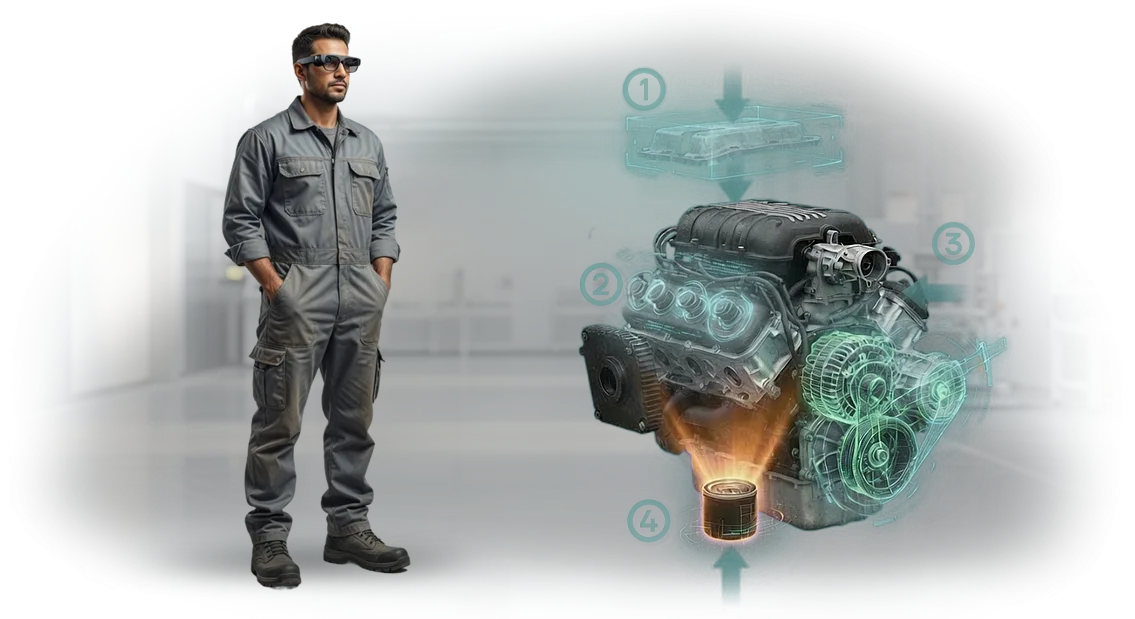
We address this pain with a remote assistant: a local specialist receives step-by-step guidance right at the worksite, while the rare expert connects remotely and sees the equipment through the employee's eyes.
Repair begins immediately, without waiting for a business trip, and the expert's knowledge applies to every site simultaneously.
This reduces downtime many times over and turns the shortage of rare specialists from a problem into a solved task — we know how to set up the process properly.
What Benefits Does a Remote AR Assistant Provide for Networks?
A remote AR assistant turns network maintenance from a chain of site visits into an operational task. The engineer on site sees hints directly in their field of view, while the specialist at the center sees what they see and can guide them step by step.
This cuts reaction time from hours to minutes: no need to wait for a mentor to arrive or to take equipment to a service center.
The main benefit for a telecom operator is reduced travel costs. An expert from the capital or another region connects to the site remotely in a couple of minutes. Site visits remain only for physical work, while diagnostics and configuration can be completed without logistics. The savings come from ticket costs, accommodation, crew downtime, and lost working hours.
Repair quality improves through unified standards. A junior employee receives support from an experienced engineer until they gain confidence.
Experienced specialists make fewer mistakes with non-standard breakdowns because they have a knowledge base and live consultation at hand. The result is fewer repeat visits and higher customer satisfaction.
Remote support also accelerates staff training and skill development. Learning happens on real tasks, without interrupting operations. Trainees start working independently faster, and experienced employees pass on skills while staying in their roles. This reduces dependence on individual experts and makes the team more resilient.
In the end, the AR assistant pays off through three directions: faster response, lower travel expenses, and consistently high repair quality.
For a telecommunications company, this is not just a convenient tool but a way to manage costs and maintain a high level of service even amid a talent shortage.
AR Assistance Formats for Telecommunications: Comparison and Selection
For telecommunications companies, equipment means hundreds of sites, and every delay at a site turns into network downtime. A field crew cannot keep all documentation in their heads, and paper instructions are inconvenient.
Augmented reality solves this problem, but each scenario — an emergency, planned maintenance, or training — needs its own format of assistance.
| AR Format | For Whom | What It Gives the Client |
|---|---|---|
| Remote assistant with AR annotation | Field crew on an emergency call when an office expert is needed | The specialist sees arrows and labels directly on the real equipment, the expert guides the actions remotely — the emergency is resolved on the first visit, repeat visits become a thing of the past. |
| AR instructions for planned maintenance | Technician inspecting base stations and communication nodes | Step-by-step hints in the field of view eliminate skipped steps in the procedure, reduce inspection time, and lower the risk of damaging expensive equipment. |
| AR simulator for training | New employees, training center interns | Practicing procedures without risk to the network, fast transition to independent work for newcomers, and fewer errors in the first month. |
The choice doesn't have to be a single one: in practice, it is convenient to combine a remote assistant for emergency situations and AR instructions for planned work.
Such a package covers the full operation lifecycle and delivers a measurable effect — fewer outages, faster commissioning of sites, higher confidence among field teams.
We will help you choose the right format for your equipment fleet and staff skill level — just describe your task.
Stages of Implementing an AR System in Telecommunications Infrastructure
Implementing an AR system in telecommunications infrastructure is a new way of working for field crews. The speed at which employees adopt the technology and the effect it delivers depend on how the stages are structured.
We run the project from immersing in your procedures to full operation, addressing a specific business need.
-
Brief and equipment audit. We study which sites you service and where downtime occurs. We identify priority scenarios for the start.
-
AR scenario design. We create the logic for step-by-step instructions with hints directly on the equipment. We add voice control — the technician’s hands remain free.
-
AR content creation. We digitize procedures: 3D models, animations, text prompts. Content is tied to components and easy to update.
-
Integration with your IT infrastructure. We connect the AR system to knowledge bases and service platforms so data is pulled in automatically. Familiar processes remain unchanged.
-
Staff training. We conduct training for engineers and technicians, from the interface to calling a remote assistant. Employees start using AR from day one.
-
Test operation and launch. A pilot on real tasks, refinements, and deployment across all departments. We track metrics: time per operation, number of errors, and learning speed.
-
Maintenance and support. After launch, we update content, monitor stability, and develop the system for new tasks in your network.
What Is Included in the Delivery Package of an AR Solution for Operations
The delivery package includes everything needed for the AR system to start working immediately after installation and not require your team to dive into development.
We provide not separate components but a ready-to-use tool for operations: from headsets to content, from configuration to support.
-
AR headsets for staff — selected according to the tasks and working conditions at sites, taking into account reliability and comfort. The equipment is adapted for long-term use.
-
AR platform software — a remote assistant system that supports video calls, instruction delivery, and recording of employee actions. Licenses are configured according to the number of users and access levels.
-
Ready-made AR instructions — step-by-step scenarios for typical operations: installation, diagnostics, and maintenance. Content is created based on your documentation, taking into account the actual equipment.
-
Integration with your systems — connection to billing, CRM, or a ticketing system. Data on completed operations automatically flows into your processes, without manual entry.
-
Training for staff and administrators — we conduct training for employees who will use the system and for those responsible for its support.
-
Technical support — available during business hours to resolve issues with system operation, instruction updates, and administration. If necessary, we connect remotely.
-
Content updates and refinements — when procedures change or new equipment appears, we adjust instructions within the agreed timeframe.
You receive a single package that does not require any additional work from your IT team. We are responsible for the solution’s performance at every stage — from delivery to daily operation.
Case: How AR Assistance Accelerated Repairs at a Telecommunications Facility
In telecommunications, equipment downtime costs more than it seems at first glance. Every hour without connectivity means disrupted negotiations, dissatisfied subscribers, and lost revenue.
When a complex breakdown occurs at a site, you have to wait for a rare specialist who may be hundreds of kilometers away — and the repair stretches on for half a day.
A large telecom operator, SvyazInvest, approached us with this problem. Its crews spent an average of five hours on equipment repairs: first diagnosing on their own, then calling an expert, waiting, and coordinating each step by phone.
We proposed implementing a remote assistant AR system: the engineer on site puts on a professional AR headset, and the expert remotely sees the image, overlays hints, arrows, and instructions on it, guiding the employee through the process.
The effect was immediate. Within a month, the average repair time fell from five to three hours. The crews learned to fix some faults on their own, without a specialist visiting the site — this reduced transportation and travel expenses by about a third.
Most importantly, network restoration speed stopped depending on where the rare expert was located: now they can connect to the site from anywhere without sacrificing quality.
For the client, this is not about technology, but about specific hours and money. Faster repairs mean fewer losses from downtime. Fewer visits mean lower maintenance costs.
If you recognize your own processes in this story, then the result will likely be similar — we will help you implement AR assistance in your service department and design a solution for your tasks.
What If Your Equipment Is Not Suitable for AR?
The direct answer: such equipment is rare. Even if your machines, instruments, or telecommunications cabinets were manufactured long ago and have no built-in sensors, that does not mean AR instructions are impossible.
We adapt to any equipment — from compact devices to large industrial lines — and you don’t need to buy new equipment for this.
Adaptation begins with an audit: we look at how your fleet is structured, what operations employees perform, and where errors most often occur. Based on this, we select a format that suits you.
It may be overlaying hints on real equipment through a tablet or smartphone camera, or it may be a remote assistant, where an expert sees the same thing as the employee and guides them by voice or visual markers.
Many people fear risks: that the idea will not work on old equipment, that employees will not accept the new system, or that implementation will drag on.
We address these risks in advance: we test the solution at your actual sites, refine scenarios before launch, and train the team. If something doesn’t fit, we change the approach rather than abandon the project.
It’s important to understand: we have different AR formats, and we choose the one that requires the least change.
In some cases, it’s enough to use regular tablets with visual hints; in others, location tracking works; and for complex components, we connect video calls with an expert. In any case, your employee receives step-by-step instructions that reduce errors and shorten training time.
Therefore, the question of whether the equipment is suitable is not a barrier for us, but a task. We take on compatibility, adaptation, and ongoing support. You receive a working tool integrated into current processes, without replacing equipment or incurring unnecessary costs.
Frequently Asked Questions About Safety and Cost of AR Support
Implementing AR support naturally raises questions: is it safe, will employees need retraining, and what will the project cost? Below are answers to common inquiries, so you understand the value and terms before starting.
The solutions we offer do not require replacing existing equipment and integrate into current processes without stopping production.
The support itself works through secure channels, so company data remains within the enterprise perimeter — this prevents leaks and unauthorized access.
Is AR support safe for equipment and employees?
Yes. We use professional headsets that do not affect equipment operation and do not cause interference. The employee sees instructions overlaid on the real object, and all commands pass through the client’s server architecture — no third-party services are involved.
Safety training takes no more than a day, and access control is configured according to your structure.
Is it difficult to train staff to work with AR?
No. The interface is intuitive: the employee sees hints directly on the screen and repeats the steps. On average, an operator masters basic scenarios within 2–3 work shifts, and experienced specialists do so even faster.
We conduct training on your real tasks, so after launch staff immediately work productively rather than studying theory.
How much does implementation cost and how quickly does it pay off?
The cost depends on the number of scenarios and the complexity of integration, but we always give the final figure before starting — with no hidden charges. The economic effect comes from reduced downtime, fewer errors, and faster onboarding of new employees.
In most cases, the project pays for itself within the first few months thanks to these factors, and the savings continue to work for you from then on.
Will I have to replace equipment to work with AR?
No. AR support works with your existing fleet — we configure scenarios for specific models and components. Integration is carried out in stages: first a pilot at one site, then rollout. This way you get results without capital expenditures or production downtime.
If you still have questions about the scenario for your facility or the specifics of your task, ask us directly — we will respond within one business day and prepare an estimate based on your situation.Request a Demo of an AR Solution for Your Infrastructure
A telecommunications specialist doesn’t need a presentation for the sake of a presentation — they need a working scenario on their equipment. That’s why we start with a short demo of AR instructions, and after that we offer a pilot and a commercial proposal.
You’ll see how an employee receives step-by-step hints right on the screen, instead of paper procedures and calls to support.
Then we follow a clear route: request → demo → pilot at your site → commercial proposal. Nothing extra: only what helps serve customers faster and make fewer mistakes.
What you get after submitting a request:
- We will agree on the demo scenario within 1–2 days for your infrastructure.
- We will show a live case: equipment setup and a remote hint to a specialist.
- We will provide pilot access for your team — you can test the solution on your own tasks.
- We will prepare a commercial proposal: timelines, stages, and scope of work.
- We will walk through how to measure the effect: operation speed, errors, onboarding of newcomers.
- We will define the implementation plan: which areas to start with and how to scale.
The demo lasts about half an hour and requires no preparation on your part. Leave a request — we’ll show the technology on your scenarios and help you move to the pilot.