

Instructions for pipeline transport: why paper no longer works
Every accident at pipeline transport facilities is not only a shutdown of pumping, but also environmental fines, reputational damage, and risk to employees' lives. The statistics are inexorable: most incidents occur due to personnel errors during equipment maintenance and repair.
Even an experienced specialist working from a paper instruction can miss a critical step — especially in a stressful situation or under poor lighting.
The problem is that paper regulations and process maps do not answer the main question: "What exactly am I doing here and now?" The employee spends time searching for the right section, cross-checking with drawings, and interpreting diagrams themselves.
Every such delay means minutes of mainline downtime, and every mistake is a direct risk of an accident. The human factor cannot be eliminated by discipline, but it can be compensated for with prompts at the right moment.
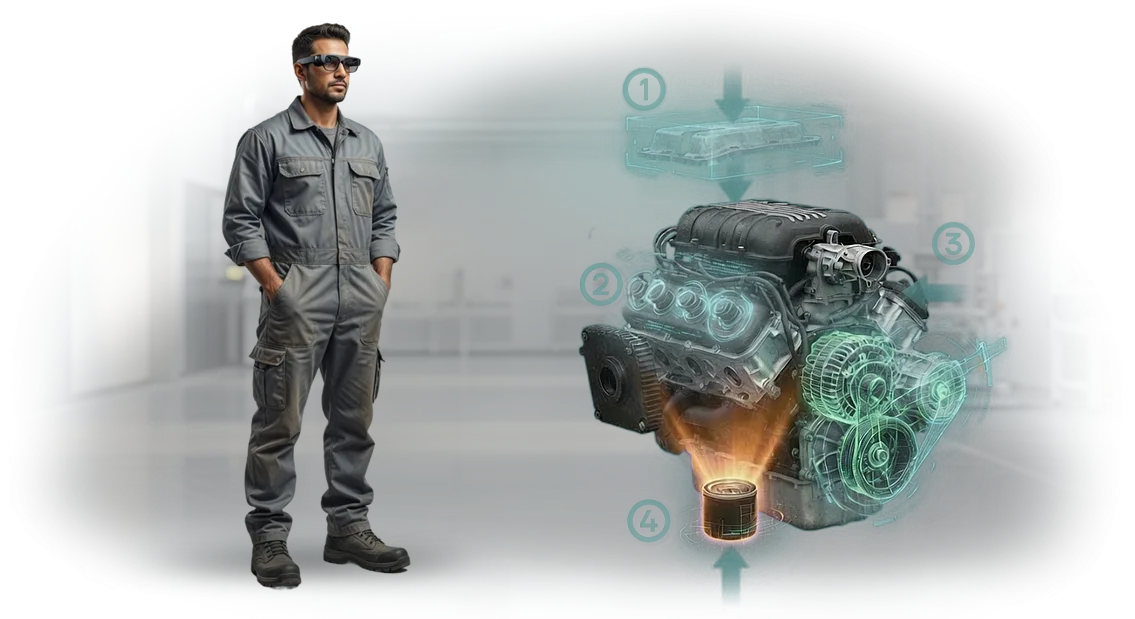
That is why we in our team develop AR instructions that project a step-by-step algorithm directly onto the equipment. The employee sees not abstract text, but the specific part that needs to be unscrewed, or the valve that should be turned.
This meets the customer's main need: to reduce the number of errors and downtime without lengthy retraining of personnel. One specialist with a tablet or augmented reality glasses performs work faster and more safely than a crew with a stack of paper regulations.
What benefits an AR instruction brings in operation and repair
An AR instruction is step-by-step guidance that appears right on the equipment: the operator sees what to do and how, without being distracted by paper or a tablet.
For an industrial enterprise this delivers a fast result: fewer errors, faster training, tighter control, and the ability to bring in an expert remotely. Our team develops such systems for pipeline transport, where the cost of an error is especially high.
Reducing personnel errors
Step-by-step augmented reality instructions eliminate guesswork: the operator performs actions in the correct order, and the system records every operation. During repair work this reduces the risk of equipment damage and repeat crew callouts.
Fast training for newcomers
A new employee sees the entire sequence of operations on the screen, so they master the procedure in a matter of days rather than weeks. Experienced staff can support several newcomers at once without stepping away from their own tasks.
Quality control and compliance with regulations
The system automatically checks whether all steps have been completed and stores the work history. The manager sees where deviations occurred and can eliminate them before they grow into a problem.
Remote expert support
If an abnormal situation arises at the site, a specialist connects remotely: they see the same thing as the operator and guides them with arrows and comments right in their field of view. This cuts response time from hours to minutes.
Reducing equipment downtime
Fast repairs and error-free operations directly affect downtime. Every hour of downtime in pipeline transport means losses, so saving time becomes a measurable benefit for the business.
These five advantages produce an overall effect: lower costs, consistent quality, and fewer emergency shutdowns. We implement AR instructions tailored to the tasks of a specific enterprise — from a single unit to an entire fleet of equipment.
AR instruction formats for your production tasks
Every production task has its own specifics: one thing is scheduled maintenance, another is dismantling a unit in field conditions or training a new employee.
That is why we do not impose a single "universal" format, but select an AR instruction for a specific operation, level of personnel training, and conditions at the site.
Below are three main formats that cover 90% of typical requests when working with pipeline transport and industrial equipment.
| Format | For whom / for what tasks | What it gives the client |
|---|---|---|
| Step-by-step overlays | For operators and repair personnel during daily operations, maintenance, and troubleshooting typical faults | The employee sees prompts directly on the equipment: what to unscrew, in what sequence, with which tool. Errors are reduced to zero, no need to keep instructions in mind or leaf through paper regulations |
| 3D models of units | For engineers, process specialists, and service crews — when it is necessary to understand the structure of a specific unit and its interaction with adjacent parts | Instead of flat drawings — a volumetric model that can be rotated and "disassembled" into parts. This speeds up diagnostics and allows more accurate repair planning even before opening the equipment |
| Repair simulation | For personnel training and practicing complex scenarios — replacement of gate valves, repair of pumping equipment, work in confined conditions | The employee trains on a virtual copy without risk of damaging equipment. After such training, actual repair is faster, and the number of emergency shutdowns decreases |
Whichever format suits your tasks, we start from existing documentation and technical regulations. You get an AR instruction that is integrated into the workflow: it launches from a smartphone or tablet, requires no special skills, and is updated when equipment changes.
How we develop an AR instruction: stages of working with you
We have structured the AR instruction development process so that you understand what happens at each stage and what results you get. You make the key decisions, and we take care of the technical part. No "black box" — only clear stages, timelines and quality control.
Stages of work
- Audit of equipment and the task. We study the documentation, regulations and actual working conditions. Together we determine which operations need to be explained to employees and what result the instruction should deliver: faster training, fewer errors.
- Approval of the scenario and layout. We show the step texts, diagrams and the sequence of actions. You make edits before content production begins — this saves time and guarantees compliance with your standards.
- AR content development. We create hints, animations and explanations that are overlaid on real equipment. You receive interim versions and see the progress, not just the final result.
- Testing at your site. We test the instruction on your equipment and with your employees. We eliminate inaccuracies and adapt it to the lighting and the specifics of the premises.
- Deployment and training. We install the solution on devices, configure access and train the staff. You receive clear instructions for use.
- Support and updates. We stay in touch after launch: we update the content when equipment or regulations change, and refine scenarios at your request.
As a result, you get a working tool that reduces training time and lowers the risk of errors. If necessary, we travel to your site for testing and deployment.
What is included in the AR instruction delivery package
The delivery package is not just an application file, but a ready-made solution that works at your facilities from day one. We have assembled everything needed for launch and daily operation: from the AR program to employee training and warranty support. Here is what you receive.
- Ready-made AR instruction for your equipment — works on tablets and smartphones and shows step-by-step actions directly on components: valves, pumps, compressors. The scenarios are adapted to the conditions of remote pipeline transport facilities.
- Admin panel — you can independently add new instructions and edit existing ones without involving developers. A regulation change is made in a couple of minutes, and employees immediately see the current version.
- Operational documentation — electronic manuals and memos for personnel that complement the AR scenarios and are available even without the internet. This is convenient when working at remote sites.
- Employee training — we conduct training for system operators and administrators: how to use the program, how to work with the admin panel, and what to do in emergency situations.
- Warranty and technical support — we fix errors, consult the team, and assist during implementation throughout the entire contract term. No additional payments for urgent on-site visits.
- Scheduled updates — we regularly release new versions of instructions when regulations change, equipment is upgraded, or new facilities are added. The system does not become outdated and always matches your processes.
Case study: how AR instructions reduced downtime of pipeline transport equipment
The customer is a major pipeline transport operator. The problem was typical for the industry: diagnostics and equipment repair took too much time, and errors during scheduled work led to repeated downtime.
We proposed supplementing standard instructions with AR prompts. The employee sees the sequence of operations directly on the equipment instead of searching for the required item in a paper procedure.
This removes the main source of delays — the human factor in reading and interpreting documentation.
What Changed After Launch
The implementation was carried out as a pilot project at three linear sections. Personnel training took two days, after which the crews worked as usual, but with AR guidance.
Results for the first month of operation:
- The repair time for a typical unit decreased by 35% — the crew spends less time checking against the instructions and moves faster to the operation itself.
- The number of errors during routine maintenance decreased by 40% — the operator sees a prompt in their field of view and does not miss critically important steps.
- Equipment downtime decreased, which directly affected compliance with the pumping schedule.
An additional effect is faster onboarding of new employees. A trainee begins working independently sooner because the system guides them through the steps.
Why it worked
We did not change existing regulations and process maps — the AR instruction works on top of them. This is important for the customer: no need to rewrite documentation, change familiar processes, or purchase new hardware.
Pipeline transport is a conservative field where any automation is treated with caution.
Therefore, we focused on reliability: the system runs on professional equipment resistant to industrial site conditions, and the instructions themselves are loaded into the device memory and do not depend on connection quality.
After the pilot, the customer expanded the project to other sections. Currently, the AR instruction is used for scheduled maintenance, and in the future — for emergency situations where every minute of downtime is critical.
What to do if your equipment is non-standard?
Many production lines and pipeline transport use equipment that does not match standard catalogs. Standard instructions do not work here: the specifics of components, operating conditions, and maintenance regulations are unique to each facility. That is why we often hear the question: what to do if the equipment is non-standard?
The answer is simple: we do not force the task into a ready-made template; we design AR instructions for your specific machinery. Specific requirements are not a limitation but source data for custom development.
We study the documentation, inspect the equipment (for example, non-standard valves or pumping units), and create a scenario that precisely matches your processes.
This approach guarantees that an employee will not encounter a description of an "alien" component or waste time searching for the right step. Each instruction is tied to the actual model, dimensions, and mounting features.
For pipeline transport, this is especially important, because an error during maintenance can stop pumping.
Custom development also includes adaptation to operating conditions: work at height, in confined spaces, at low temperatures. The interface and sequence of actions are adjusted to real scenarios, not to an ideal picture. As a result, the employee receives a prompt that appears exactly where and when it is needed.
If you doubt whether a standard format will suit you, do not doubt it — we will make it for your case. Tell us about your equipment, and we will propose a solution that removes risks and speeds up training. Write to us — together we will find the answer.
Common customer concerns about implementing AR instructions
Doubts before implementing AR instructions are a natural reaction, especially in such a responsible field as pipeline transport. Customers fear that staff will not accept the new technology, that it will require serious investment, or that it will force them to buy VR equipment.
We have been working with industrial enterprises for years and know which questions arise most often.
Let's break down the main objections — from cost to implementation complexity. The answers will help assess how augmented reality fits into existing processes and what is needed to start.
Is it difficult to train staff to work with AR instructions?
No. The interface is intuitive: large prompts with step numbers appear on the tablet screen. The employee does not need to memorize anything — all data is displayed directly on the screen over the equipment. 10–15 minutes of practice is enough to master it.
How expensive is the implementation of AR instructions? The main part of the costs is content development for your equipment, not purchasing hardware. No simulators or special kits are needed. Regular tablets and smartphones that the staff already have will do. The investment pays off through reduced downtime and fewer maintenance errors.
Will we have to buy VR equipment? No. Augmented reality (AR) overlays instructions on a real object, while virtual reality (VR) completely replaces the environment. A tablet or smartphone is enough for AR instructions. Augmented reality glasses are convenient when your hands are busy, but this is an optional feature.
How quickly will we launch the system, and will it interfere with work? Implementation is carried out in stages: first a pilot area, then scaling to the required departments. Production does not stop, and we connect to existing systems through secure integrations. We take on training and support.
Order the development of AR instructions for your equipment
When it comes to implementing AR instructions for pipeline transport equipment, the main questions are always the same: what we will get, when we will launch, and how much it costs. We answer them with specifics — even before development begins.
An order starts with a short consultation, during which we clarify your task and propose the optimal augmented reality format for your employees.
After contacting us, you receive a complete package for decision-making. We don't ask you to take our word for it — we show how an employee's work with AR instructions will look and what results it will bring.
- Consultation on AR use scenarios — no generalities, only in relation to your sites and operations.
- A prototype of the future instruction on your equipment — you see how convenient it is to work with prompts, even before final development.
- A transparent estimate that records all work and stages — with no hidden payments or "additional options".
- Development and launch timelines that we agree with you and fix in the contract.
- Post-implementation support: adaptation, training, and employee support.
To order an AR instruction, you just need to leave a request on the website. We will contact you within one business day, clarify the details, and prepare a consultation, prototype, estimate, and timelines. Then you simply make a decision, and we take on the entire technical part.