

Why the Pulp and Paper Industry Needs AR Instructions
Staff errors when working with industrial equipment are one of the main causes of downtime and accidents at pulp and paper enterprises.
An employee skipped a routine operation, mixed up the sequence of steps, or incorrectly assessed parameters — the line stops, an emergency situation arises, and expensive repairs and recovery time are required.
In continuous production, the cost of such a mistake increases many times over. Equipment downtime means missed shipment schedules, lost revenue, and increased load on other sections.
An accident means the risk of costly downtime lasting days, and in the worst case, a threat to personnel safety.
Training all operators to work with complex machinery using only paper documentation is practically impossible: knowledge is lost, experienced specialists leave, and newcomers act blindly.
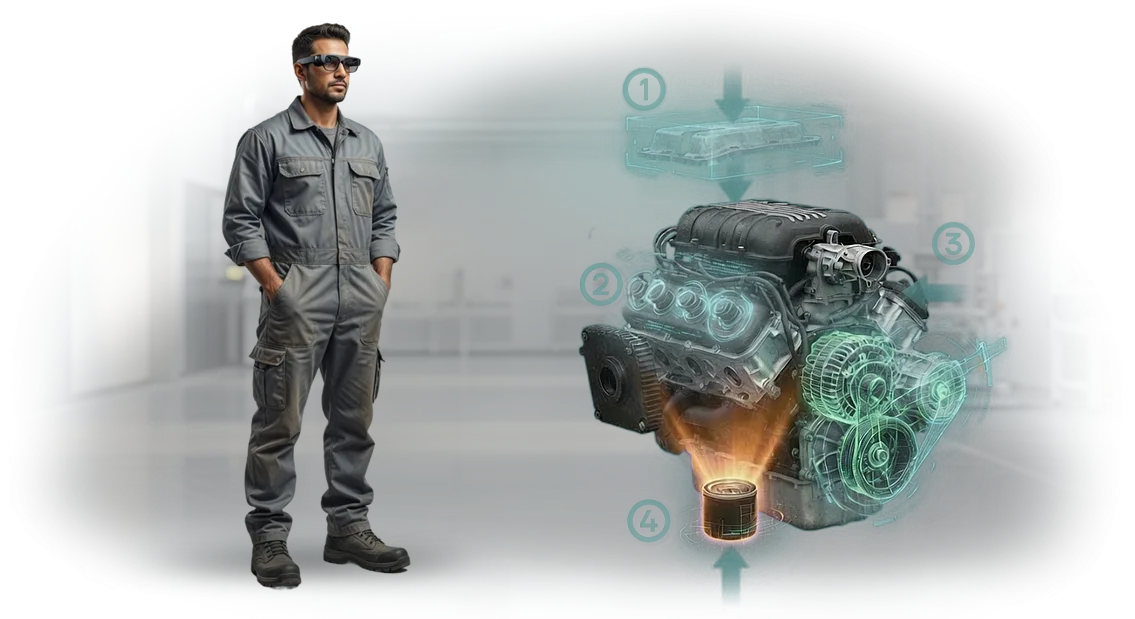
This is exactly why the pulp and paper industry needs AR instructions. An augmented reality system shows directly on the equipment what to do and in what order: it highlights components, displays control values, and prompts the sequence of actions.
The operator works more confidently, makes fewer mistakes, and in complex cases can quickly call a remote assistant.
The implementation of AR instructions already delivers measurable results: the number of staff errors decreases, downtime and accident rates drop, and production efficiency grows.
Our team has been developing such systems for industry for 10 years and knows how to adapt them to your equipment and procedures. Tell us about your task — we will show how AR instructions will improve the reliability of your processes.
Key Benefits of AR Instructions for Production
Pulp and paper production means continuous cycles, complex machinery, and a high cost of downtime. Any operator error or prolonged repair translates into lost revenue.
Conventional paper instructions do not help: studying them takes hours, and in a stressful situation an employee still acts blindly.
AR instructions change the approach. The worker sees prompts, connection diagrams, and the sequence of operations directly on the equipment — no need to shift attention to a screen or flip through a manual.
This reduces the number of errors in standard operations and allows a newcomer to perform tasks with near-expert accuracy after short training.
For the pulp and paper industry, this also means faster onboarding: new employees get up to speed more quickly without lengthy mentoring.
A separate scenario is remote repair support. An engineer at their computer sees the real equipment through the employee's camera, and the AR system overlays markup, arrows, and comments onto the image.
The expert does not waste time traveling, and repairs do not wait for a specialist to arrive. Equipment recovery time is reduced, which means less downtime and better plan performance.
We build such systems on professional hardware and proven tools, so results remain stable even in noisy workshops with high vibration. AR instructions pay for themselves from the very first repairs — thanks to the speed and error-free performance of the staff.
AR Instruction Formats for Different Tasks
Each production task requires its own format for presenting information: some things are more convenient to show on a tablet, others on a smartphone, and for complex operations or remote support, professional augmented reality glasses work more effectively.
A correctly chosen format directly affects employee training speed and the number of errors during equipment repair and maintenance.
In the pulp and paper industry, typical scenarios vary: from a newcomer's initial introduction to the line to emergency troubleshooting when a specialist is hundreds of kilometers away. Below is a table of AR instruction formats that we develop for specific customer tasks.
| Format | For whom | What it gives the client |
|---|---|---|
| Mobile AR instructions (smartphones) | New employees, technical staff without special devices | Fast on-the-job training: the employee points the camera at the equipment and sees step-by-step prompts. Time-to-competency and the number of errors in standard operations decrease. |
| AR on tablets | Engineers, shift supervisors working with complex procedures | A large screen for detailed diagrams and drawings, convenient for multi-step setup or repair processes. Downtime is reduced by decreasing the time spent searching for the right information. |
| Augmented reality glasses | Specialists for remote support, hazardous areas | Frees up the employee's hands, allows working in hard-to-reach places, and connecting a remote expert. The expert sees the same thing as the worker and gives instructions in real time — this reduces problem resolution time many times over. |
We select the format based on the task and the specifics of your production. For pulp and paper mills, a combination is often optimal: mobile instructions for mass training, tablets for complex procedures, and AR glasses for emergency situations and remote assistance.
As a result, you get a flexible system that covers the needs of newcomers, experienced engineers, and the logistics of field crews.
Turnkey AR Instruction Development Stages
Working on AR instructions is not a "black box" but a transparent process with fixed stages and checkpoints. We designed it so you always understand what is happening and can influence the outcome before the solution goes into production.
-
Brief and equipment audit. We discuss the tasks, collect procedures and diagrams, and determine which operations need to be covered by instructions. The output is a technical specification that fixes the scope and timeline.
-
Prototype and approval. We prepare a demo version at a real site or on a specific piece of equipment. You see how an employee will interact with the instruction and can make edits without reworking the entire system.
-
Content development. We create step-by-step scenarios, visual prompts, and voice guidance. Everything is designed so that a specialist in the workshop understands the actions at a glance, without flipping through paper manuals.
-
Testing in production. We test the instruction with the participation of your technologists and operators. We take real feedback into account, fix inaccuracies, and adapt the solution to the specific conditions of the site.
-
Deployment and training. We configure access, install software on devices, and conduct a short training session for staff. We hand over the rights and stay in touch — at this stage the client receives a fully ready tool.
The result is a predictable launch without downtime: from brief to deployment, there is a minimum number of iterations, and each stage is documented.
You do not pay for "changes along the way" — you get an AR instruction that employees start using within the first few days.
What Is Included in the AR Instruction Delivery
When ordering AR instructions, you receive not just technology but a complete working package — from scenarios to staff training. We adapt the solution to your equipment and processes; all you have to do is put it into operation.
- Ready-made instruction scenarios. We develop step-by-step scenarios for repair, maintenance, and setup of your equipment, including emergency situations. The operator sees the order of actions and checkpoints — mistakes are eliminated.
- 3D models of components and mechanisms. They allow you to examine equipment from all sides, understand its structure, and disassemble a unit without opening it. This reduces training time and the risk of damage during repairs.
- Integration with your maintenance system. AR instructions work together with your maintenance system: procedures, operation numbers, and statuses are pulled in automatically. Control and statistics are in one window, without manual data transfer.
- Staff training. We conduct training for engineers and operators: interface, scenario navigation, quick information search. Personnel start working immediately after deployment, including on your equipment.
- Technical support. Post-launch support: scenario updates, model refinements, consultations. When equipment or procedures change, we adapt the instructions to the new reality.
This package covers all stages — from an employee starting work on the line to maintenance quality control. You get a working system that pays for itself by reducing downtime and errors.
Case Study: AR Instructions for the Pulp and Paper Industry
At a pulp and paper production facility, every hour of downtime means lost revenue and missed shipments. New operators need weeks to master the components and procedures, while experienced employees rely on memory in emergency situations and make mistakes.
Errors are costly: restarting equipment takes hours and requires repair crews. Teaching everyone to act equally correctly is nearly impossible while knowledge lives in people's heads rather than in the work process.
We solved this problem at one of the mills — we implemented AR instructions on top of the existing procedures. Through a tablet, the operator sees directly on the equipment which component to check, where to press, and what moment is considered normal.
No thick manuals and no switching between documents: the entire process is prompted step by step, on the spot.
Results on the Line
Fault-finding time dropped from 40 to 7 minutes, and the frequency of erroneous actions during startup fell by half. Line downtime due to the human factor decreased by a third — that is several additional working shifts per month.
For the client, this also means shipment predictability: fewer emergencies, and smooth warehouse and logistics operations.
Savings for the Client
It took only four months for the project to pay for itself through reduced downtime and faster onboarding of new operators. After the first results, the mill ordered the next sections from us — now AR instructions cover two more production stages.
We continue to support the system: procedures are updated centrally and immediately reach all employees.
Frequently Asked Questions About Implementing AR Instructions
Implementing AR instructions raises questions — that is normal. We have collected answers to the most common ones so you can see how the technology will fit into your production.
How long does implementation take?
In a typical project, the first instructions for one piece of equipment are ready within a few weeks. We then scale the solution across the entire fleet, breaking the work into stages with intermediate demonstrations of results.
Is it difficult to integrate AR with our systems?
No. We use your existing documentation, procedures, and 3D models — no manual data transfer is needed. Employees get access through familiar tablets and smartphones, and when the network is unstable, the instructions work without an internet connection.
What equipment do we need to purchase?
Nothing unusual. Standard tablets or smartphones that your team already has will work. The platform adapts to your devices, and rugged cases for the workshop are an option, not a mandatory requirement.
How much does it cost and when will it pay off?
The cost is calculated individually after the brief and is fixed in the contract. The investment pays off through reduced downtime, fewer errors, and faster training of new employees — the effect is visible within the first months.
Order AR Instruction Development
When ordering AR instruction development for the pulp and paper industry, you receive a comprehensive solution rather than scattered files. We take on all stages: task analysis, scenario creation, development, deployment, and support. All you need to do is set the task and accept the result.
What is included in the order:
- AR instruction scenarios for key operations: commissioning, repair, maintenance, diagnostics.
- 3D models and animations that "come to life" over the real equipment through a tablet or smartphone.
- Interface adaptation to the operators' skill level — no special knowledge required.
- Integration of AR instructions into your system of work orders, procedures, and quality control.
- Staff training on working with the AR system (conducted remotely or on site).
- Full support during launch: we help with implementation in the workshops and answer questions.
- Technical support after delivery: scenario updates, adding new components, consultations.
Each item on this checklist addresses a specific production task. Instead of searching for different contractors — one for 3D, another for programming, another for training — you get a single turnkey result.
We specialize in industrial AR solutions and know the specifics of pulp and paper mills: working with machinery, safety requirements, and the characteristics of the facilities.
We work remotely, but this does not affect quality — all stages are recorded in the plan and regularly approved.
Leave a request — and within two days you will receive an implementation plan for AR instructions for your equipment. Then we will walk the path from scenarios to support together with you.
How to Choose the Right AR Instruction Format?
There is no single universally correct AR instruction format — the decision depends on the specific task, type of equipment, and usage scenario.
This is especially relevant for the pulp and paper industry: large-scale machinery, remote sections, and conditions of high humidity and dust. Therefore, the format should be chosen not from a catalog but based on the specifics of your production and staff.
The key question is who will use the instruction and how. An operator at a machine needs short step-by-step prompts right in their field of view, without distracting them from work.
A repair crew at a remote site may need a remote assistant: a specialist sees the image from the employee's camera and guides them through a complex unit by voice.
It is also important whether the network is available, how critical minutes of downtime are, and which devices are already in use.
In practice, we start with a consultation: we analyze your task, study the equipment, clarify working conditions and staff skill levels. After that, we propose the optimal solution — from simple animated diagrams overlaid on the machinery to a full AR remote assistant system.
As a result, you get an instruction that personnel will actually use, not just see in a presentation.
Budgets vary, and we do not try to sell the maximum through unnecessary features. If a simple format solves the task — we will say so.
If phased implementation is needed — we will propose a plan where you get a working result within your financial capabilities and can expand the system later. The choice of format affects service speed, the number of errors, and the training of new employees.
We invite you to a consultation: we will review your case, show examples from related industries, and help you choose the optimal solution for your task and budget. Leave a request on the website or call us — we will explain how it will look on your specific equipment.