



Your printed materials are losing to competitors? AR printing is the solution
A printed catalog, brochure, or flyer is a familiar sales tool that works silently. A client opens a page, sees a static image, and forgets it 10 seconds later. If competitors are already using interactivity, their materials stand out, while yours get lost in the noise.
AR printing turns a static medium into an interactive one: point your smartphone camera at a page — and it "comes to life." Essentially, it's bringing a catalog to life without reprinting the run: instead of a flat photo — a 3D model, a review of key features, or a video. For the client it's convenient; for you, it's a minute of attention that translates into a sale.
The numbers speak for themselves: a purchase reinforced with augmented reality is made 40% faster, and 63% of users consider AR tools useful and are willing to come back. In other words, you get not just a beautiful brochure, but a tool that holds attention and leads to an order.
Technically, nothing complicated: we overlay an AR layer on your existing layout without changing the design. We work with professional tools, so the result is stable on any device.
You don't need to reconfigure production — printing goes on as usual, and the interactivity appears after pointing the camera.
We develop AR printing turnkey: from selecting scenarios for bringing materials to life to launch and ongoing support. Send us your catalog layout, we'll show which pages to enhance with interactivity, and calculate the budget based on your specific task.
What bringing printed materials to life does for business
Ordinary brochures, flyers, and packaging quickly lose the client's attention — they are static and give no reason to linger. AR printing turns familiar media into an interactive experience: point your smartphone camera — and a 3D model, video, or animation appears on the page. This holds attention for 2–3 minutes longer than ordinary viewing.
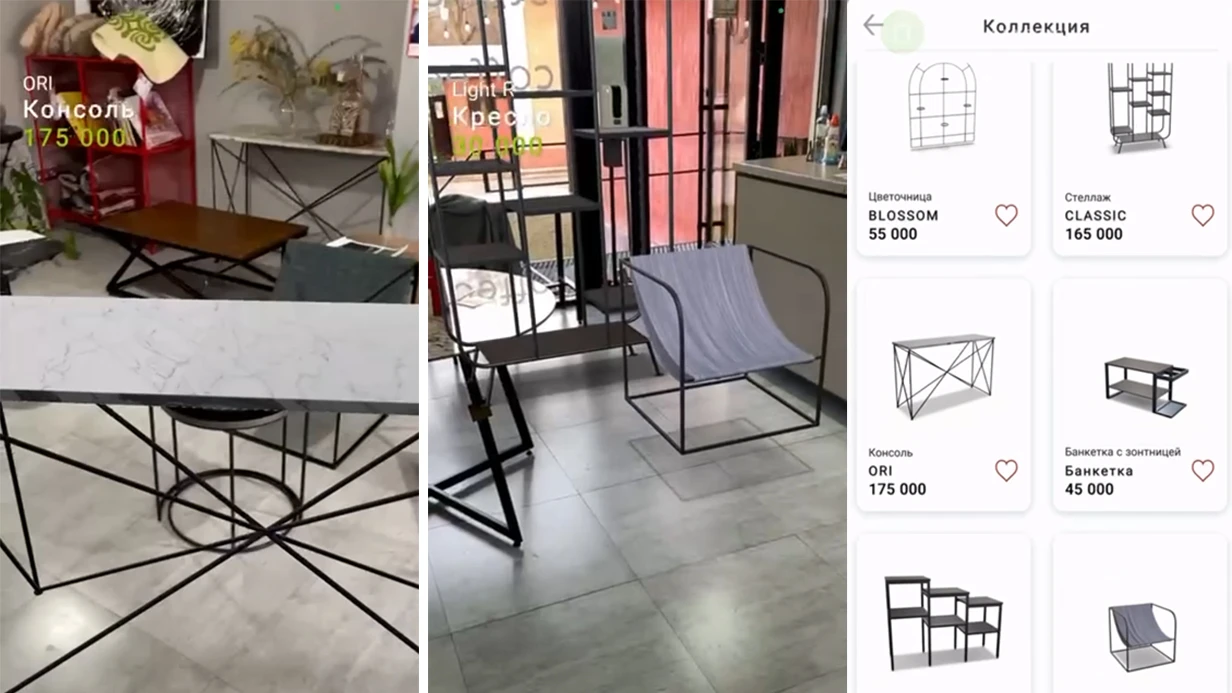
Conversion growth starts with the first touch. For example, in a furniture catalog, a buyer opens the AR button and sees a sofa in their room — doubts disappear, the purchase decision speeds up.
For corporate brochures, it's a way to show the product in action without a visit to a warehouse or factory. Any static page with AR becomes an interactive salesperson that works around the clock.
Customer retention is built on impression. When a client receives not just a postcard, but a postcard with a video greeting or a branded mini-game, they remember such a contact and come back again.
Repeat engagement with such a material happens up to 5 times more often than with an ordinary one, which means the chance of a repeat sale is higher.
Brand recognition is amplified by a viral effect. Interesting AR printing prompts people to take photos, share in messengers and social networks, and mention the brand in discussions.
Each such repost is free reach to a new audience, which directly increases recognition and improves the company's image as modern and tech-savvy.
Technologically, this is implemented without difficulties for the client: customizable QR codes and markers that are recognized by an ordinary smartphone camera.
We use professional equipment and well-tuned tools, so bringing printed materials to life happens quickly, and the result works reliably on any modern device. The client doesn't need to install anything or train staff — just place the AR marker on the layout.
AR printing formats: from business cards to product catalogs
Ordinary printing today barely holds attention: a business card is usually glanced at for a couple of seconds and put away. AR printing turns a paper medium into an interactive one — pointing a smartphone camera shows a video, 3D model, presentation, or a contact button.
This makes each piece of media a mini communication channel and doesn't require the client to install an app.
We select AR printing formats for a specific business task — from a small business card to a catalog with dozens of pages. Here are the main scenarios most often ordered:
| Format | For whom | What it gives the client |
|---|---|---|
| AR business cards | Sales managers, executives, agencies | The business card is impossible to throw away — it opens a portfolio, a short video, or saves the contact in one tap |
| AR catalogs | Trading companies, manufacturers with a wide assortment | Live product presentation: the client sees the product in 3D, with specifications and price, without going to the website |
| AR brochures | Event agencies, museums, educational centers | The brochure turns into a tour or instruction: text, video guide, route map — all in one medium |
| AR posters | Concert, exhibition, and festival organizers | The poster shows a trailer, teaser, or event timeline — generates interest before the event even starts |
As you can see, any business that already spends on printing fits. By adding AR markers to your current print run, you get measurable feedback: you understand how many times content was opened, which sections are in demand, and how quickly the audience moves to action. This makes printing not just beautiful, but effective.
We implement AR on any medium that interacts well with the design — the result looks like part of the brand, not a technical experiment. You only need to launch the format once to see the difference in client response.
The process of creating augmented reality: from brief to launch
We run every AR printing project as a full-fledged production: with clear stages, checkpoints, and an understandable result at each step. You always know what's happening and when you'll receive the finished product — no "black boxes."
Stages of working on AR printing
-
Brief and immersion in the task. We define the project goal: what augmented reality should do — increase sales conversion, hold attention at a booth, train an employee. We gather preferences on audience, style, and usage scenario.
-
Concept and scenario development. We propose AR mechanics options: from a simple "coming to life" image to an interactive quest with user choice. We show how each option serves your task and recommend the optimal one in terms of effect-to-budget ratio.
-
Layout and trigger approval. You provide the design layout or finished printed material, and we adapt it for recognition. We check how the object will be read by the camera and, if necessary, provide technical recommendations — so the launch goes without surprises.
-
AR project assembly and content setup. We edit animation, video, 3D objects, and the interface. You receive an intermediate version for review and make edits to texts, colors, and scene durations.
-
Testing on real devices. We check performance on different smartphone and tablet models, including weaker ones. We work through scenarios with poor lighting and different tilt angles — so that your clients' experience works on the first try.
-
Launch and handover of materials. We provide ready QR codes or links, user instructions and, if necessary, train staff. Placement on your website and social networks is done in one day.
-
Post-launch support. We monitor activation statistics, quickly fix any issues if needed, and help update content if promo terms or design change.
The entire process takes from 5 to 15 business days depending on the complexity of the scenario. You get control at every stage and a clear result, not "it'll be ready sometime."
What's included in the augmented reality delivery package
When you order AR printing, you receive not just a "coming-to-life picture," but a full-fledged promotion tool.
The delivery package includes layouts, instructions, source files, and support — everything you need to launch the project without a developer and without delays.
- Ready layouts for print and screen — designs you can use as is: for print runs, booth screens, and social media posts.
- Activation instructions — a simple step-by-step document for your staff: how to point the camera, which settings to use, what to do in case of failures.
- Source scene files — all AR project materials are stored with you. You can make changes or hand them over to another contractor.
- Test run on your equipment — we check how the scene works on visitors' smartphones or your team's tablets.
- Scene management panel — a simple admin interface to change texts, images, links, and promo codes at any time.
- Post-launch support — for the first month we're in touch: we answer questions, help update content, and fix errors.
This package covers the client's main fears: "what if it doesn't work" and "what if we can't figure it out." You get a working tool with instructions and edits, not a "black box." If you need to expand functionality — we're in touch, but the basic launch doesn't depend on us.
Case study: how bringing a catalog to life increased sales by 27%
When a client has a 200-page catalog and managers spend 15 minutes explaining specifications — both time and deals are lost. The trading house "Orion" came to us with this pain: they needed to speed up product selection and reduce the load on the sales department.
We proposed bringing the catalog's key pages to life using AR printing. No apps to download — you point your smartphone camera at a page, and the product model appears right on the table.
The client can "rotate" it, look at colors and configurations, without waiting for a manager's response.
Implementation results
Two months after launch, the sales department noted: consultation time nearly halved, and catalog sales grew by 27%. Products with animated pages were ordered 2 times more often than those without AR markers.
The numbers speak for themselves: conversion from inquiry to deal increased by a third, and repeat orders from clients who used the AR catalog increased by 18%. For the company, this means a fast return on investment and clear revenue growth without expanding staff.
Client feedback
The head of Orion's commercial department summed it up: "Previously, we carried samples with us or hoped the client would take our word for it. Now he sees the product in real size himself — and almost no arguments about specifications remain."
We didn't just make "coming-to-life pictures" — we integrated AR into the sales process: from the first demonstration to order placement. This is a classic AR case where technology brings measurable value to business rather than just decorating a presentation.
Answering common questions about implementing augmented reality
When it comes to augmented reality in printed products, clients tend to have the same questions. Is the technology difficult to implement, what changes in the layout, what kind of paper is needed, and how quickly will everything be done?
We address the most common doubts — so you understand the stages of work and can make a decision without unnecessary risks.
Will we need to redo the brand identity or layout?
No, we don't require changing the design. The AR marker is overlaid on finished printed material — the logo, images, and texts stay as they are. We only need the original layout from you; our specialists will prepare the materials themselves.
Are there requirements for paper and type of printing?
Regular offset or digital printing on most types of paper works fine. The main thing is that the image is not too dark or glossy, as this can reduce recognition accuracy. We check your material before launch and provide recommendations if anything needs adjustment.
How long does it take to create AR printing?
The basic version — a catalog, business card, brochure, or postcard with augmented reality — is ready in 3–5 days. If you need a complex scenario with animation, video, or 3D objects, the timeline extends to 1–2 weeks. We set the specific launch date in the contract so you know the deadline.
What devices will the installations work on?
On any modern smartphones and tablets. The user doesn't need to download a separate app — just point the camera or open a link in a mobile browser. This removes the barrier for visitors and doesn't create extra steps before engaging with the brand.
If you have remaining questions about implementation — write to us, we'll show examples of similar projects and calculate timelines.Order augmented reality development for your business
Augmented reality opens new ways to interact with your audience, but implementing it often scares people with complexity and unpredictable budget.
We remove these risks: we take the project turnkey and support it from the first idea to launch at your event or in a permanent exhibition.
What you get after contacting the studio:
- Consultation — we analyze your task and advise where AR will deliver maximum effect, before the estimate is calculated.
- Individual proposal — we prepare a solution tailored to your goals: attract visitors, hold attention, increase time spent interacting with the product.
- Transparent estimate and timelines — we lock in cost and dates at the start, so you stay within budget.
- Turnkey development — from scenario and design to programming and testing on real equipment.
- Integration with the media you need — printed materials, signage, packaging, exhibitions: AR markers work where it's convenient for your clients.
- Support at launch and beyond — we help with setup, train staff, and stay in touch if refinements are needed.
We've been working remotely for over 10 years and have completed hundreds of projects for museums, brands, and event organizers. This means you get a well-tuned process and a predictable result, not an experiment.
Leave a request for a consultation — we'll discuss how augmented reality can work specifically for your business. You can order AR development right now: just write to us, and within a day we'll send an individual proposal.
How to choose the right augmented reality format for your task?
Choosing an augmented reality format starts not with technology, but with the task: what should the audience do after the interaction — remember the brand, examine the product, share on social media, or make a purchase.
This determines which medium will work: animated print, an AR zone at an event, or an interactive display window. The same principle defines the selection criteria: reach, duration of contact, and the place of meeting with the user.
If your goal is maximum reach with a run of brochures, catalogs, or packaging, AR printing is the optimal choice. Just point your smartphone camera at the marker — and a 3D model, video, or order link appears.
This solution works without installing apps, so it suits a wide audience and provides measurable scan statistics.
For events and museum spaces, where visitors are already at the right location, AR zones with contactless object recognition are more often chosen — guests interact with the digital layer right at the booth or in the exhibition.
The key criterion is matching the task in terms of usage scenario. If the client should see the result at home after the event, you need a medium they can take with them. If the task is to engage a visitor in live action, a stationary AR zone is more appropriate.
We also consider how often the scenario will repeat: for seasonal promotions, a simple solution is enough; for a permanent exhibition, deeper development is needed.
We capture the goal, audience, and expected result in the brief, then select the format and build a prototype that can be tested before production. You get not scattered technical elements, but a ready-made tool for a specific marketing task.